Ingredients
Method
Cook the Quinoa
- Rinse the 200g of quinoa thoroughly under cold running water in a fine-mesh strainer for 30–60 seconds — quinoa has a natural bitter coating called saponin on its outer hull that makes unrinsed quinoa taste noticeably soapy. Most commercial quinoa is pre-rinsed but a second rinse at home ensures complete removal. In a medium saucepan, combine the rinsed quinoa with 400ml of vegetable stock rather than plain water. The stock's sodium and mild vegetable flavour infuse the quinoa during cooking — producing a more flavourful base than plain-water quinoa that provides background depth to the assembled bowl rather than a neutral, slightly bland filler. Bring to a boil over high heat, then reduce immediately to the lowest possible setting, cover tightly, and simmer for 15 minutes until all the liquid has been absorbed. Remove from heat and allow to stand covered for 5 minutes without lifting the lid — the resting period distributes any residual steam evenly through the quinoa and allows the grains to firm slightly from the cooling pot. Fluff with a fork using a light lifting motion. The correctly cooked quinoa should have a small spiral — the germ — visible on each grain, indicating complete cooking.
Marinate the Skirt Steak
- Remove the skirt steak from the refrigerator 15 minutes before cooking to bring it toward room temperature — cold steak placed directly on a hot pan creates a large temperature differential between the cold interior and the ambient exterior that causes the outside to cook significantly faster than the inside, making it more difficult to achieve the correct medium-rare throughout. Pat the steak completely dry on all surfaces with paper towels — surface moisture produces steam rather than the direct-heat caramelisation that constitutes a proper sear. In a small bowl, combine the 20ml of olive oil, 15ml of lime juice, 10g of chopped cilantro, 8g of cumin, 5g of smoked paprika, 5g of garlic powder, 3g of chili powder, and generous kosher salt and black pepper. Stir into a paste. Rub this mixture evenly across every surface of the steak — both sides and the edges — pressing it into the meat. Allow to marinate for 10–15 minutes at room temperature while the quinoa finishes cooking and the dressing is prepared. The lime juice's acidity very slightly denatures the outermost surface proteins and allows the spice compounds to adhere; the 10–15 minute window is sufficient for surface flavour penetration without breaking down the steak's texture.
Make the Cilantro-Lime Dressing
- In a small bowl, combine the 40g of Greek yogurt, 15ml of lime juice, 20g of roughly chopped fresh cilantro, 5ml of olive oil, and 10g of minced jalapeño. Whisk vigorously until completely smooth — the olive oil will not fully emulsify with the yogurt and lime without a binding agent, but vigorous whisking disperses it sufficiently to distribute evenly when drizzled. Add a small splash of water — 15–20ml — while continuing to whisk until the dressing reaches a pourable, drizzling consistency rather than the thick, spoonable consistency of plain yogurt. Season with kosher salt and taste — the dressing should be simultaneously bright from the lime, herbaceous from the cilantro, warmly spiced from the jalapeño, and creamy from the yogurt without the dairy heaviness of a full crema. The Greek yogurt base is the specific choice that makes this dressing specifically lighter than a sour cream or crema version while retaining the creaminess and tang that connect it to the bowl's Mexican-adjacent flavour profile. Refrigerate until assembly.
Cook the Skirt Steak
- Heat a large skillet or grill pan over the absolute highest available heat until smoking hot — skirt steak's flavour and texture are both optimised by very high heat and very short cooking time, and insufficient heat produces grey, steamed surfaces without the Maillard caramelisation that the steak's specific character requires. Remove the marinated steak from the bowl, shaking off any thick excess marinade — pooled marinade on the steak's surface will burn rather than caramelise. Place the steak flat on the smoking surface and cook undisturbed for 3–4 minutes until the underside shows deep, dark caramelised colour with slight char marks. Flip and cook the second side for 3–4 minutes for medium-rare — internal temperature of 54–57°C at the thickest point. Skirt steak is a thin cut with a relatively large surface area, meaning it cooks through rapidly — do not leave unattended during the final 60 seconds. Transfer to a cutting board and rest for 5 minutes. The resting period allows the juices driven to the surface by the sear's heat to redistribute back through the meat — slicing immediately after the pan produces visibly more juice loss and a perceptibly drier eating texture.
Slice the Steak
- This is the most technique-critical step for skirt steak. Skirt steak has a very pronounced, clearly visible muscle grain — the fibres run obviously in one direction across the length of the cut. Identify the direction of these fibres and cut strictly perpendicular to them — against the grain — into thin strips approximately 5mm thick. Cutting against the grain shortens each individual muscle fibre so every piece requires minimal effort to bite through. Cutting with the grain on skirt steak produces long, intact fibres that are noticeably tough and chewy regardless of internal temperature or rest time. The grain direction in skirt steak is more obvious than in most cuts — it is worth pausing to identify it clearly before slicing.
Char the Vegetables
- Without cleaning the skillet, add the 10ml of olive oil over medium-high heat. Add the 200g of halved cherry tomatoes cut-side down in a single layer — the cut surface against the hot oil produces the blistered, caramelised char that makes the tomatoes specifically more flavourful than simply warmed tomatoes. Leave completely undisturbed for 2–3 minutes until the cut surfaces show deep golden-brown to charred patches. Add the 150g of corn kernels directly to the pan alongside the charring tomatoes. The corn's natural sugars caramelise against the hot surface within 1–2 minutes, developing the slightly smoky-sweet charred corn character. Cook for a further 2 minutes, stirring the corn occasionally while leaving the tomatoes undisturbed, until the corn shows light char in spots. Season with salt and pepper. The steak's fond remaining in the pan from the sear contributes additional depth to both vegetables during this charring step.
Assemble the Bowls
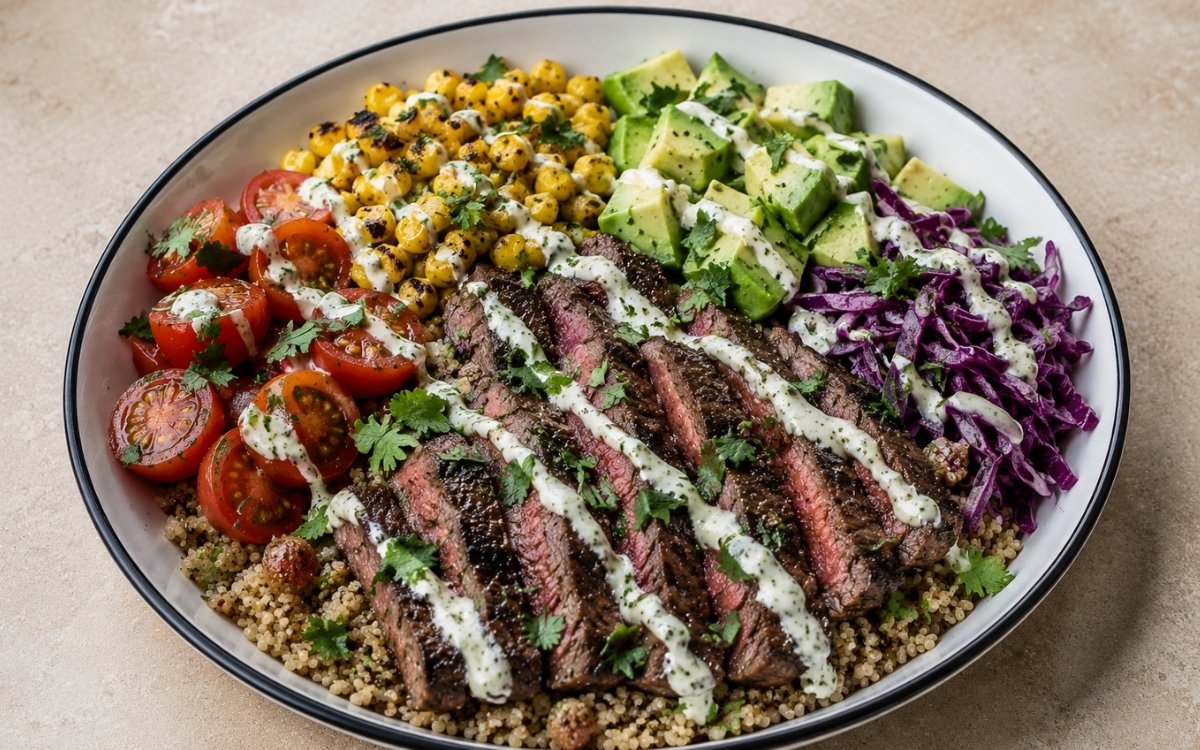
- Divide the quinoa among four wide bowls. Working with distinct sections, arrange each component: the sliced steak fanned or overlapped so the medium-rare interior is visible; the charred tomatoes and corn in their own section with accumulated pan juices; the diced avocado in its own section — diced immediately before assembly to prevent oxidation; and the shredded red cabbage in the remaining space. The red cabbage is served raw — its specific crunchy, slightly bitter, slightly peppery character provides the textural and flavour contrast against the warm, spiced components that makes each forkful more interesting. Drizzle the cilantro-lime dressing generously across each bowl — extending it from the steak across the quinoa and reaching every component. Scatter fresh cilantro leaves over each bowl. Serve with lime wedges alongside for squeezing at the table.
Notes
Skirt steak is specifically the correct cut for this bowl — not for its prestige but for its specific characteristics that make it well-suited to this preparation. Skirt steak has a more pronounced beefy flavour than most other cuts at its price point, owing to its high myoglobin content and generous fat marbling. It cooks very quickly at high heat — the thin, flat format produces a caramelised surface within minutes. And its pronounced grain direction makes the against-grain slicing technique both more important and more easily executed than on thicker cuts where the grain is less visible.
Quinoa cooked in vegetable stock is a small but meaningful upgrade from plain water. The stock's sodium seasons the grain throughout rather than only at the surface, and its mild vegetable compounds infuse the quinoa with background depth that makes the assembled bowl taste more complete at the base level. Use a low-sodium stock — regular stock can oversalt the quinoa as it concentrates during absorption.
The cilantro-lime Greek yogurt dressing is the component that makes this bowl specifically lighter than other steak bowls in this collection. Greek yogurt's protein content and low fat provides creaminess without the caloric weight of crema, sour cream, or mayo-based dressings, and its tanginess has a specific dairy-lime brightness that complements the cumin-paprika-chili spiced steak.