Ingredients
Method
Assemble the Skewers
- Thread one half hot dog onto a wooden skewer, cut-side facing upward. Place one mozzarella piece directly on top so it sits flush against the hot dog's cut end — the mozzarella should cap the skewer without any skewer tip exposed above it. Repeat for all 12 skewers. Place the assembled skewers on a baking sheet and refrigerate. Cold skewers are not optional — the temperature differential between the cold filling and the warm batter is what makes the batter adhere cleanly on contact rather than sliding off.
Make the Yeasted Batter
- Add the 6g of instant yeast to the 360ml of warm water at approximately 37°C — warm enough to activate the yeast but not hot enough to kill it. Whisk briefly to combine. In a large bowl, whisk together the 340g of flour, 4g of salt, and 60g of sugar until evenly distributed. Pour the yeast-water into the flour mixture and whisk until completely smooth with no lumps remaining. Cover the bowl tightly with plastic wrap and allow to rise at room temperature for 30 minutes. After 30 minutes the batter should have increased slightly in volume and will show small bubbles across the surface — the yeast activity that makes this batter specifically lighter and slightly chewier than a standard unleavened corn dog coating.
Par-Boil and Chill the Potatoes
- Place the diced russet potatoes in a saucepan and cover with cold water. Season generously with salt. Bring to a boil and cook for exactly 2–3 minutes — the potatoes must remain firm rather than tender. They are being par-boiled for adhesion, not eating; fully cooked potatoes will break apart when rolled onto the battered skewer rather than adhering as distinct cubes. Drain immediately and spread in a single layer on a baking sheet. Refrigerate until fully cold. Cold potatoes adhere to the battered surface more effectively than warm ones — their firm, cold surface grips the batter and holds in place during the panko-rolling step.
Heat the Oil
- Fill a large, deep, heavy-bottomed pot just over halfway with the vegetable oil. Heat to 175°C. Set a wire cooling rack over a baking tray alongside the pot for draining. Maintain the oil temperature actively throughout frying — cold corn dogs entering the oil drop the temperature significantly and the heat must be raised immediately to restore it before the next batch.
Set Up the Coating Station
- Pour the risen batter into a tall glass or jar — the tall, narrow container allows each skewer to be dipped and coated in a single motion by submerging vertically. Place the chilled diced potatoes in a shallow tray alongside the batter. Place the 200g of panko breadcrumbs in a second shallow tray. Work quickly from this point — the batter, potato, and panko coating sequence must be executed while the skewers are still cold.
Coat the Corn Dogs
- Remove the skewers from the refrigerator. Working one at a time, dip each cold skewer fully into the batter — submerging the entire hot dog and mozzarella section down to the batter line. Hold above the glass for 3–4 seconds to allow excess batter to drip off. Immediately roll the battered skewer in the chilled potato cubes, pressing gently as you roll to compact the potatoes into the batter surface. Work quickly so the potatoes contact the batter while it is still tacky — potatoes rolled onto dried batter will not adhere. Without delay, roll the potato-coated skewer in the panko breadcrumbs, twirling the skewer between your fingers to build an even, complete crust across the entire surface. Press gently to compact the panko into the potato layer. If at any point the batter appears to be sliding or loosening — a sign that either the skewer or the batter has warmed — return the skewers to the refrigerator for 5 minutes and place the batter container in the freezer for 3 minutes before continuing.
Fry with Continuous Rotation
- Hold each coated skewer by its exposed handle and lower it slowly and steadily into the 175°C oil. The moment the corn dog enters the oil, begin rotating the skewer continuously between your fingers — a constant, steady rotation that turns the corn dog slowly throughout the entire frying period. The continuous rotation is the technique that produces the smooth, even, domed Korean street-food shell. Without rotation, one side of the corn dog rests against the pot's bottom or wall, flattening and browning unevenly while the other side remains pale. Continuous rotation ensures every surface is in contact with the hot oil for an equal amount of time and that the batter sets as a symmetrical, smooth cylinder. Fry 1–3 at a time depending on pot size — never crowding. Fry for 3–4 minutes until deeply golden brown and uniformly crisp across the entire surface. Transfer each finished corn dog to the wire rack.
Finish with Sugar and Salt
- While each corn dog is still hot — within 30 seconds of leaving the oil — sprinkle very lightly with granulated sugar and a pinch of fine salt. The combination of hot surface, residual oil, and the slight crystalline crunch of sugar and salt is the specific Korean street-food finish that balances the richness of the mozzarella and the savoury coating with sweet-salty contrast. Do not skip this step and do not apply it once the corn dog has cooled — the salt and sugar adhere to the hot, slightly oily surface rather than falling off a dry cooled crust.
Make the Gochujang Sauce
- In a medium bowl, whisk together the 180g of mayonnaise, 85g of sriracha, 30g of gochujang, 25g of honey, 10ml of toasted sesame oil, and 20ml of rice vinegar until completely smooth and uniformly coloured. Transfer to a squeeze bottle for the specific controlled drizzle application characteristic of Korean street food presentation.
Serve
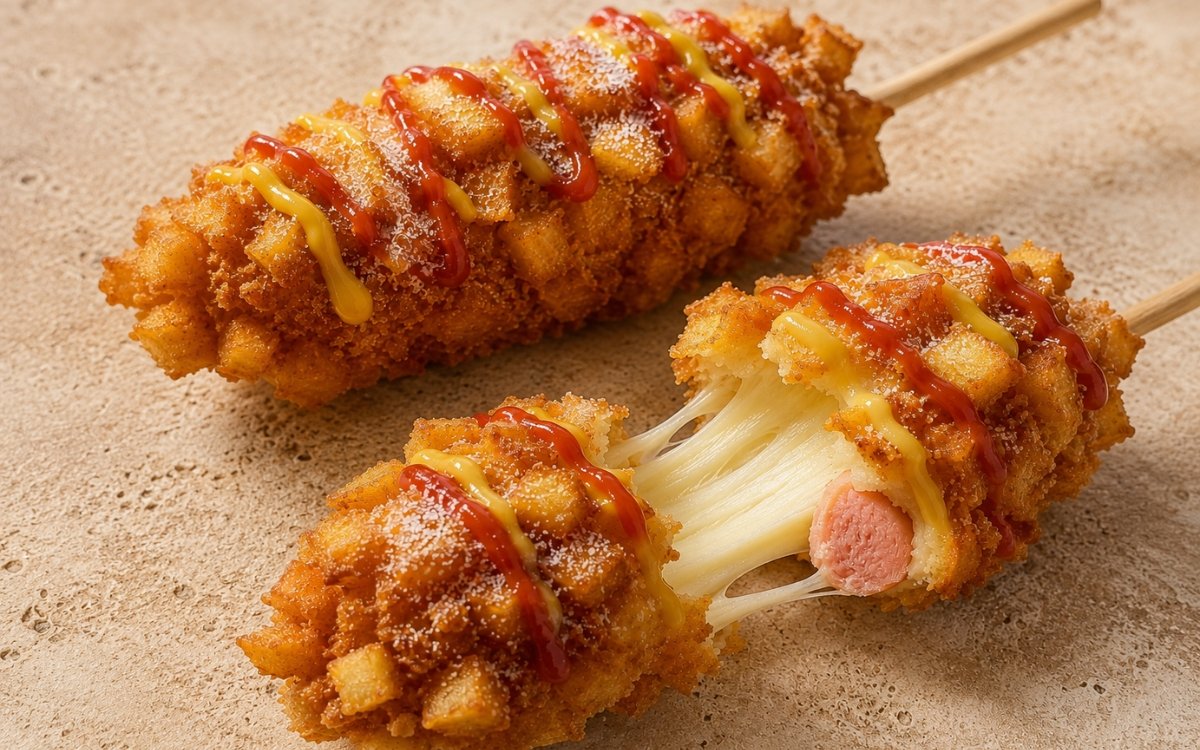
- Drizzle each hot corn dog generously with the gochujang sauce in a zigzag pattern along its length. Serve immediately — Korean corn dogs are at their maximum textural quality in the first 3–5 minutes after frying while the mozzarella is fully molten and the crust is at peak crispness.
Notes
The yeasted batter is the single most important distinction between a Korean corn dog and an American corn dog. The yeast produces carbon dioxide during the 30-minute rise period, aerating the batter with micro-bubbles that create a lighter, slightly chewier coating during frying. An unyeasted batter produces a denser, more bread-like result without the specific springy-yet-crisp texture of the Korean version. The 30-minute rise is also what allows the batter to be made from pantry staples rather than requiring buttermilk or leavening acids.
The par-boiled potato coating is the visual and textural signature of Korean corn dogs — the feature that immediately identifies them as the Korean version rather than any other corn dog style. The diced potatoes adhere to the outer batter surface and fry into individual golden cubes, producing a rough, textured, dramatically crunchy exterior that contrasts completely with the smooth batter beneath and the stretchy mozzarella inside. The three-layer textural experience — shattering potato crust, springy yeasted batter, and molten cheese — is what makes Korean corn dogs specifically more compelling than any single-layer preparation.
Low-moisture mozzarella is specified rather than fresh mozzarella for a specific technical reason. Fresh mozzarella has a very high water content — when heated to the frying temperature, the water converts to steam and produces a watery, potentially leaking cheese that loses its stretch. Low-moisture mozzarella's reduced water content allows it to melt and stretch without steaming, producing the characteristic long, dramatic pull of molten cheese on the first bite.