Ingredients
Method
Prepare the Udon Noodles
- Bring a large pot of water to a full rolling boil. Add the 600g of fresh udon noodles and cook for 2 minutes, stirring gently throughout to separate the strands — fresh udon's surface starch causes them to bond together rapidly, and any clumps that form in the cooking water will not separate during wok cooking. Drain through a colander, rinse briefly under cold running water to stop the cooking and remove excess surface starch, and shake thoroughly to remove excess water. Toss immediately with the 5ml of toasted sesame oil to prevent sticking. Set aside — the udon must be fully ready before the wok is turned on, as the wok cooking sequence moves too quickly for concurrent preparation.
Whisk the Sauce
- In a small bowl, combine the 45ml of soy sauce, 30ml of mirin, 10ml of toasted sesame oil, 60ml of kimchi juice, 10g of sugar, and 1g of black pepper. Whisk until the sugar has completely dissolved and the mixture is uniform. The kimchi juice is the ingredient that most defines this sauce's character — it is not a byproduct to discard but an active flavour component carrying the fermented, slightly spicy, acidic brine that the kimchi itself developed over its 2–3 weeks of aging. At 60ml, it provides a concentrated background fermented depth throughout every noodle strand that simply adding more kimchi to the stir-fry could not achieve. Combined with soy sauce's deep savoury umami and mirin's sweet glaze, the sauce produces the specifically Korean-inflected stir-fry flavour that distinguishes this from yaki udon or any other Asian noodle preparation. Set beside the wok.
Sear the Pork Belly
- Heat the wok or 14-inch skillet over the highest available heat for 2–3 full minutes until wisps of smoke appear from the surface. Add the 30ml of neutral oil and swirl to coat. Add the 450g of thinly sliced pork belly strips in a single layer — work in two batches if the wok cannot accommodate all the pork without crowding. Leave undisturbed for 90 seconds. The thin pork belly strips at this temperature develop a crispy, golden-caramelised exterior and render a significant amount of fat into the wok — this rendered pork fat becomes the enriched cooking medium for every subsequent ingredient. Flip each strip and cook for 60 seconds on the second side. Push the pork to the outer edges of the wok and add the 30g of minced garlic and 20g of minced ginger to the clear centre. Stir-fry the garlic and ginger in the centre for 20 seconds — the concentrated heat at the wok's centre and the surrounding pork fat combine to bloom the aromatics explosively quickly. Bring the pork down from the edges and add the 150g of thinly sliced yellow onion and the white parts of the scallions. Toss everything together and stir-fry for 2 minutes until the onion begins to soften and show caramelisation at its edges.
Add Mushrooms and Kimchi
- Add the 200g of sliced shiitake mushrooms to the wok. Stir-fry for 2 minutes, allowing brief stationary contact between the mushrooms and the hot wok surface between each stir — the contact produces caramelisation at the mushroom edges, converting their surface moisture into concentrated flavour rather than steam. The mushrooms will shrink by approximately half and show golden-brown colouring at their thinner edges when ready. Add the 400g of roughly chopped aged kimchi and gochugaru. Stir-fry vigorously for 2 minutes — keep the kimchi moving but allow brief moments of direct contact with the hot surface. The kimchi's natural sugars and fermented compounds caramelise at the spots of direct contact, producing the slightly charred, slightly smoky kimchi character that is the flavour highlight of this dish. Perfectly aged kimchi that has been fermenting for 2–3 weeks provides both the correct flavour complexity and structural integrity for high-heat stir-frying — freshly made kimchi is too crisp and lacks the fermented depth; over-aged kimchi becomes too sour and breaks down under wok heat. The charred spots are not mistakes — they are the intended result and the primary source of the dish's depth.
Add Noodles, Sauce, and Butter Finish
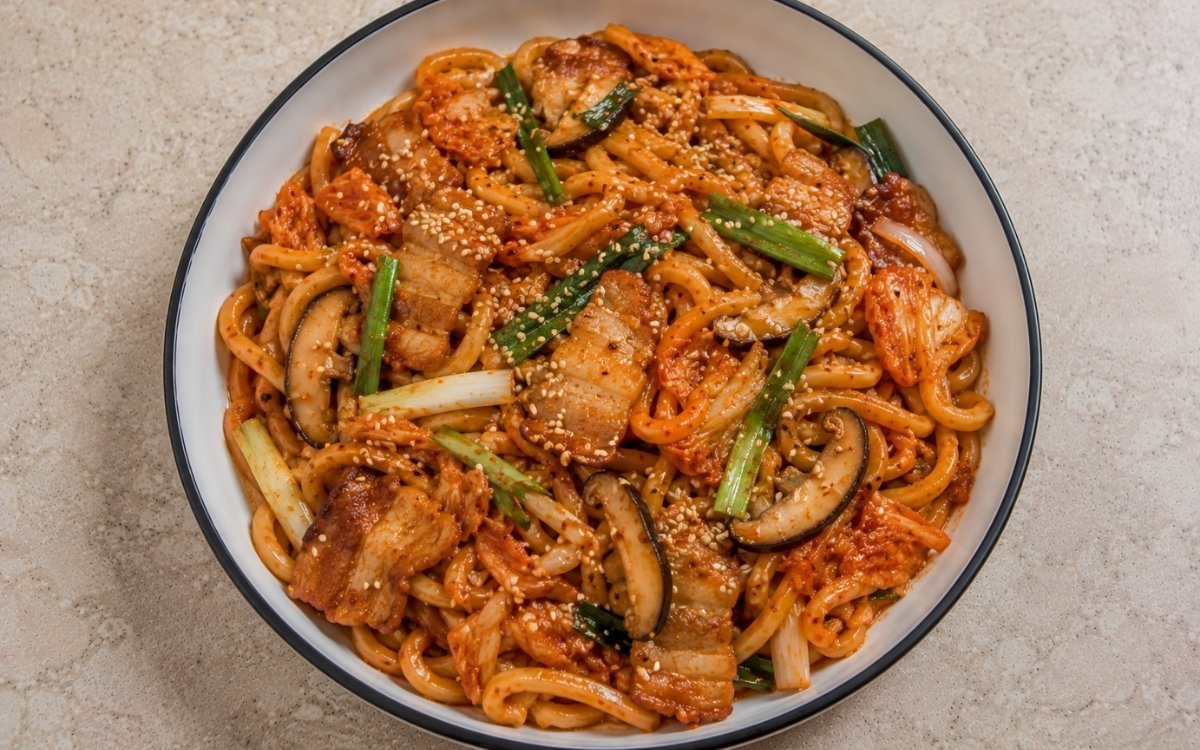
- Add the sesame-tossed udon noodles to the wok using tongs to separate any clumps that may have formed during the wait. Pour the entire sauce mixture over the noodles. Toss continuously for 2 minutes — lifting from the bottom of the wok and folding over the top, turning the noodles through the sauce and the charred kimchi-pork mixture. Every strand should be coated in the glossy, slightly thick sauce. During the tossing, allow the noodles to make brief contact with the wok surface — these moments of direct heat produce slight crisping on individual noodle surfaces, the textural contrast between chewy interior and slightly crisped exterior that is specific to properly wok-cooked udon. Remove from heat completely. Immediately add the 30g of butter, the green scallion parts, and half of the 15g of toasted sesame seeds. Toss for 30 seconds as the residual heat melts the butter — the butter's fat disperses into the hot sauce as it melts, producing the silky, slightly rounded finish that smooths the boldness of the kimchi and gochugaru into something with more cohesion and less sharp edge. The butter finish is the element that most people cannot identify by name but immediately register as making the dish feel more complete.
Serve
- Divide among four bowls immediately — udon continues absorbing the sauce and the noodles lose their specific chewy-crispy texture contrast quickly after leaving the wok. Scatter the remaining sesame seeds over each bowl. Serve immediately while the noodles are steaming hot.
Notes
Aged kimchi at 2–3 weeks is the specific fermentation stage that produces the best stir-fry kimchi. Fresh or very young kimchi (under 1 week) is crisp and mildly fermented — its texture holds through stir-frying but it lacks the deep, funky, acidic complexity that defines mature kimchi's flavour contribution. Very old kimchi (over 4 weeks) has fermented to the point of significant sourness — its acidity is pronounced and its texture has softened, which produces an excessively sour stir-fry as the acidity concentrates during high heat. At 2–3 weeks, kimchi has developed complex lactic acid fermentation character, retained some structural integrity, and still has a vibrant, deep flavour without overwhelming sourness. Most commercial kimchi available in Korean grocery stores is sold at this stage and labelled for stir-frying.
The butter finish in a Korean-style stir-fry is a fusion technique that has become increasingly standard in contemporary Korean cooking and Korean-Japanese restaurant dishes. Butter has no traditional place in classical Korean cooking, but its fat composition specifically complements fermented Korean flavours — the butter's mild sweetness moderates kimchi's sharpness, and its dairy fat produces a satiny mouthfeel that oil alone does not. The technique of adding cold or room-temperature butter off the heat to a hot sauce is the same principle as the French beurre monté — the fat disperses into the sauce as small droplets as it melts, creating an emulsified, glossy finish.
Gochugaru — Korean coarse red pepper flakes — provides a different heat character from the gochujang paste that many Western Korean recipes use. Gochugaru is dry, slightly fruity, and produces a building, pervasive warmth that integrates with the charred kimchi's spice. At 7g it is a generous quantity that produces a prominently spiced dish.