Ingredients
Method
Prepare the Kimchi
- Drain the kimchi thoroughly. Squeeze it gently with clean hands or press it in a sieve to remove excess liquid. Roughly chop it into shorter bite-size pieces. If the kimchi is very juicy, place it in a dry skillet over medium heat for 1–2 minutes, just long enough to steam off excess moisture. Do not cook it until soft or browned — the goal is only to dry it slightly. If needed, add the 1 tsp sugar and stir briefly to round out the acidity. Transfer to a plate and let it cool slightly. The kimchi should be flavorful and still vivid red, but not dripping with juice. This is what keeps the bread from steaming and going soggy. Kimchi's fermentation process produces genuinely more liquid, and more aggressively flavoured liquid, than a typical raw vegetable would release — squeezing and pressing addresses the bulk of that moisture mechanically, while the brief dry-skillet step handles whatever remains without pushing the kimchi toward actually cooking down.
Build the Sandwiches
- Lay out the bread slices. Butter one side of every slice evenly, all the way to the edges. Turn 4 slices over so the unbuttered side faces up. Divide about half of the mozzarella between those 4 slices. Spread it in an even layer. Top with the drained chopped kimchi, keeping it mostly in the center and not overloading it. Season very lightly with black pepper. Top with the remaining mozzarella, then close each sandwich with the remaining bread slices, keeping the buttered side facing outward. Cheese should sit both below and above the kimchi. This traps the kimchi in place and helps the sandwich hold together when the cheese melts. Sandwiching the kimchi between two cheese layers rather than placing it directly against either slice of bread does genuine double duty — it anchors the filling structurally once the cheese melts, and it acts as a moisture barrier protecting the bread from whatever liquid the kimchi still carries even after draining.
Griddle the Sandwiches
- Heat a skillet or griddle over low to medium-low heat. Place the sandwiches in the pan and cook in batches if needed. Cook for 3–5 minutes per side, pressing very lightly with a spatula only to encourage even contact. Adjust the heat as needed so the bread turns deep golden and crisp without burning before the cheese melts. If the bread is coloring too quickly before the cheese melts fully, lower the heat and cover the pan loosely for 30–60 seconds to help the heat penetrate. Flip carefully and cook the second side until equally deep golden and the mozzarella is fully melted and stretchy. The bread should be deeply golden, evenly crisp, and buttery, while the cheese is completely melted. The sandwich should feel crisp outside and soft, gooey, and cohesive inside. This low, patient heat is calibrated specifically around the substantial amount of cheese and kimchi filling packed into the sandwich — a hotter pan would brown the bread well before that filling has had time to fully melt through and heat.
Rest and Slice
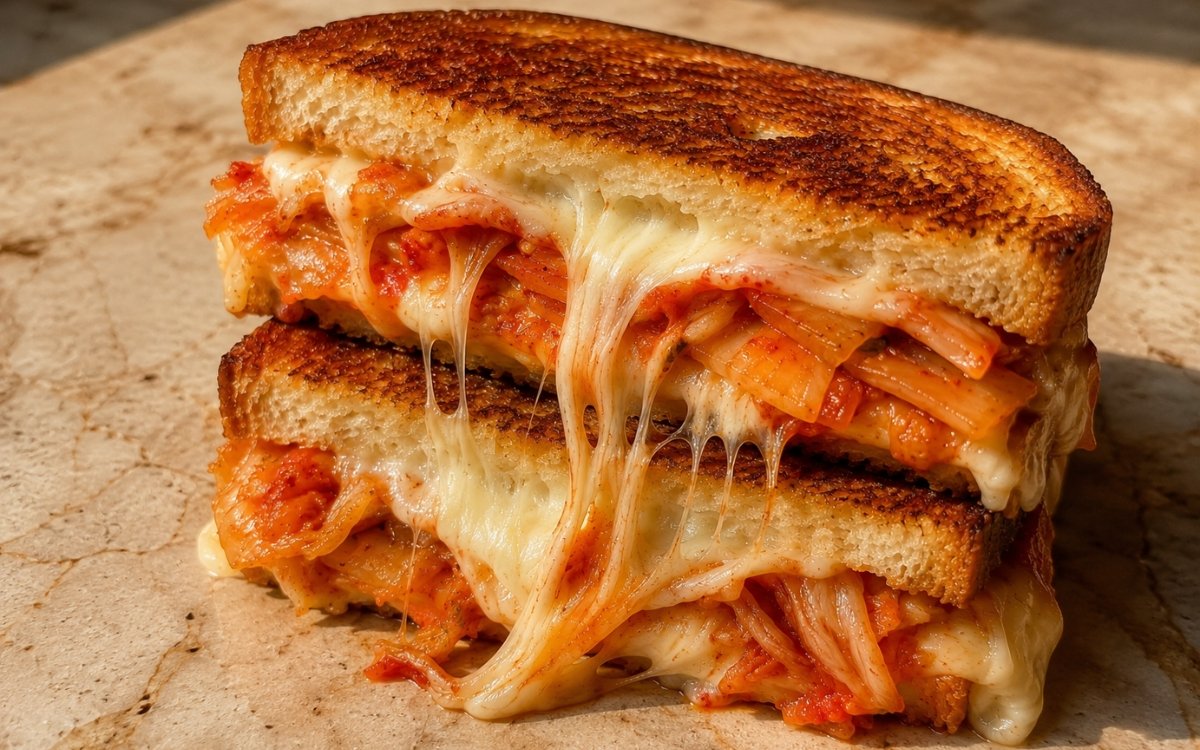
- Transfer the sandwiches to a rack or board and let them rest for 1 minute so the cheese settles slightly. Slice each sandwich in half. For the best presentation, stack the halves so the kimchi and mozzarella cross-section shows clearly. Resting briefly prevents the filling from sliding out too aggressively while still preserving the dramatic cheese pull. Cheese straight off the griddle is at its most fluid; this brief pause lets it firm up just enough to hold together cleanly when cut, without cooling so much that it loses its stretch.
Notes
The aggressive draining and drying given to the kimchi in this recipe deserves genuine respect as the single most consequential step in the whole process. Kimchi carries considerably more liquid — and more assertively acidic, fermented liquid — than most vegetables typically added to a grilled cheese. Squeezing it by hand or pressing it through a sieve removes the bulk of that moisture mechanically, and the optional brief dry-skillet step addresses whatever remains, without ever pushing the kimchi toward actually cooking down into something soft and browned.
Placing cheese on both sides of the kimchi, rather than only on one, is worth understanding as serving two distinct functions simultaneously. Structurally, the melting cheese on both sides binds the whole sandwich together once it's cut, helping the filling stay cohesive rather than sliding apart. Protectively, that same cheese layer sits directly between the kimchi and the bread on both sides, acting as a barrier against whatever residual moisture the kimchi still carries even after thorough draining.
The specifically low, patient griddling heat reflects a genuine timing tension in this particular sandwich, given how much filling is packed inside relative to a standard grilled cheese. A hotter pan would brown and crisp the bread's exterior considerably faster than the substantial mozzarella-and-kimchi filling can fully melt and heat through — the low heat specified here exists to let both processes finish in roughly the same window.
Choosing low-moisture mozzarella specifically over fresh mozzarella is worth understanding as a genuine structural requirement rather than a minor preference. Fresh mozzarella carries meaningfully more water content, and releasing that extra moisture directly into an already kimchi-adjacent sandwich would work against everything the careful kimchi-draining step was meant to protect.