Ingredients
Method
Prepare the Baguettes
- Cut each baguette in half crosswise to make 4 sandwich portions. Slice each piece lengthwise, leaving one side slightly attached if possible so the sandwich opens like a hinge. The baguette should be fresh, crusty outside, and airy inside. If the crust is stale or leathery, refresh it in a hot oven for 3–4 minutes, then let it cool slightly before filling. Leaving one side lightly hinged rather than cutting all the way through keeps the ham contained neatly within the bread once folded in, rather than risking slices sliding out from an open, fully separated split.
Butter the Bread
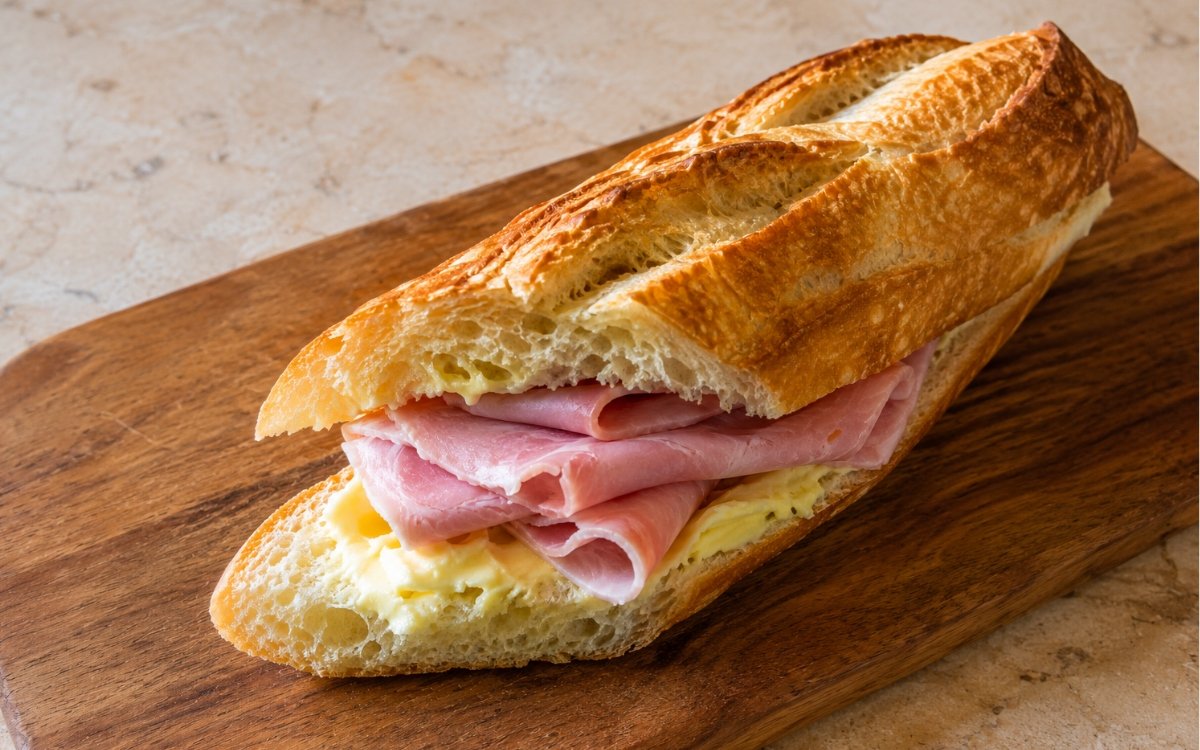
- Spread the softened butter generously over the bottom half of each baguette. Use enough butter to create a visible creamy layer against the crumb. The butter should be soft and spreadable, not melted. Melted butter disappears into the bread and loses the classic jambon-beurre texture. The bread should not be hot when buttered. Warm bread melts the butter too quickly and makes the sandwich greasy instead of creamy. Butter at room temperature holds its own structure well enough to spread as a distinct, visible layer against the crumb — melted or even just gently warmed butter instead soaks directly into the bread's airy interior, disappearing rather than staying as the creamy component this sandwich is built around.
Add the Ham
- Fold the ham slices loosely and layer them into each baguette. Use about 40–50g ham per sandwich, depending on the size of the bread. The ham should be folded, not pressed flat. The folds create volume and give the sandwich the correct bakery-style look and texture. Loosely folded ham traps small pockets of air between its layers, which is what gives the finished sandwich real visual height and a softer bite — ham pressed flat into a single dense layer looks thinner and eats more compactly, losing the light, gently voluminous texture a proper jambon-beurre is known for.
Close and Serve
- Close each sandwich gently without compressing it too much. Serve immediately. A proper jambon-beurre should feel simple but not dry — crisp bread, visible butter, soft folded ham, and a clean salty-creamy finish. Closing the sandwich only gently, without pressing it down, is what preserves the ham's folded volume and keeps the bread's crisp crust intact rather than crushing it flat.
Notes
Keeping the butter genuinely soft rather than melted deserves to be understood as the single technique this entire sandwich is built around, given how few ingredients it has to hide behind. Properly softened butter holds its own body and spreads as a visible, creamy layer directly against the bread's crumb — melted butter, by contrast, has no such structure left and simply soaks straight into the baguette's airy interior, disappearing entirely rather than remaining a distinct, tasteable component of the sandwich.
Folding rather than flattening the ham is worth respecting as a real technique decision, not simply an aesthetic flourish. Ham layered in loose folds naturally traps small pockets of air between its slices, producing genuine visual volume and a softer, lighter bite than the same amount of ham pressed into a single flat sheet. That folded structure is a recognisable hallmark of how a proper bakery or boulangerie builds this exact sandwich.
The instruction against buttering hot bread reflects the same underlying principle as keeping the butter soft in the first place. A freshly baked or freshly refreshed baguette carries real residual heat, and that heat would melt the butter on contact just as effectively as pre-melting it would — letting the bread cool slightly first is what protects the butter's intended texture and appearance right up until the sandwich is assembled.
The recipe's explicit instruction to keep the sandwich to only baguette, butter, and ham — resisting the temptation to add cheese, lettuce, tomato, or sauces — reflects the dish's core identity rather than an arbitrary restriction. Jambon-beurre's whole appeal rests on the genuine quality of three simple components speaking for themselves; adding further ingredients would move the sandwich toward something else entirely, no longer the specific, minimalist classic this recipe is built around.