Ingredients
Method
Make the Honey Syrup
- Add the honey, hot water, and salt to a small jug. Stir until completely smooth. Let it cool before using. The honey needs to be diluted into syrup first. Straight honey does not dissolve cleanly in cold coffee and will sink to the bottom in a sticky layer. Honey's naturally thick, viscous consistency behaves very differently from a granulated sugar syrup — even a small amount added directly and cold sits stubbornly rather than dispersing, which is exactly why the hot water dilution step exists, loosening it into something that can actually integrate evenly once it meets the coffee.
Prepare the Cold Brew Base
- Make sure the cold brew is fully chilled and strong. Add 15–20ml honey syrup to each glass. Pour in 180ml cold brew per glass and stir well to combine. The honey should be fully integrated into the coffee before the almond milk goes in. If it is not stirred now, the drink will taste uneven — bitter at the top and too sweet at the bottom. Combining and stirring the honey syrup into the coffee at this early stage, before any other component is added, gives it the most direct, uncomplicated opportunity to distribute evenly — attempting the same mixing later, once ice and almond milk are already in the glass, would be considerably less effective.
Add Ice
- Fill each glass generously with ice. The drink depends on being properly cold. Weak ice or warm cold brew makes the almond milk taste thin and the honey taste heavy. A properly cold foundation is what keeps every subsequent component — the almond milk especially — reading as crisp and refreshing rather than diluted or flat once it's added.
Add the Almond Milk
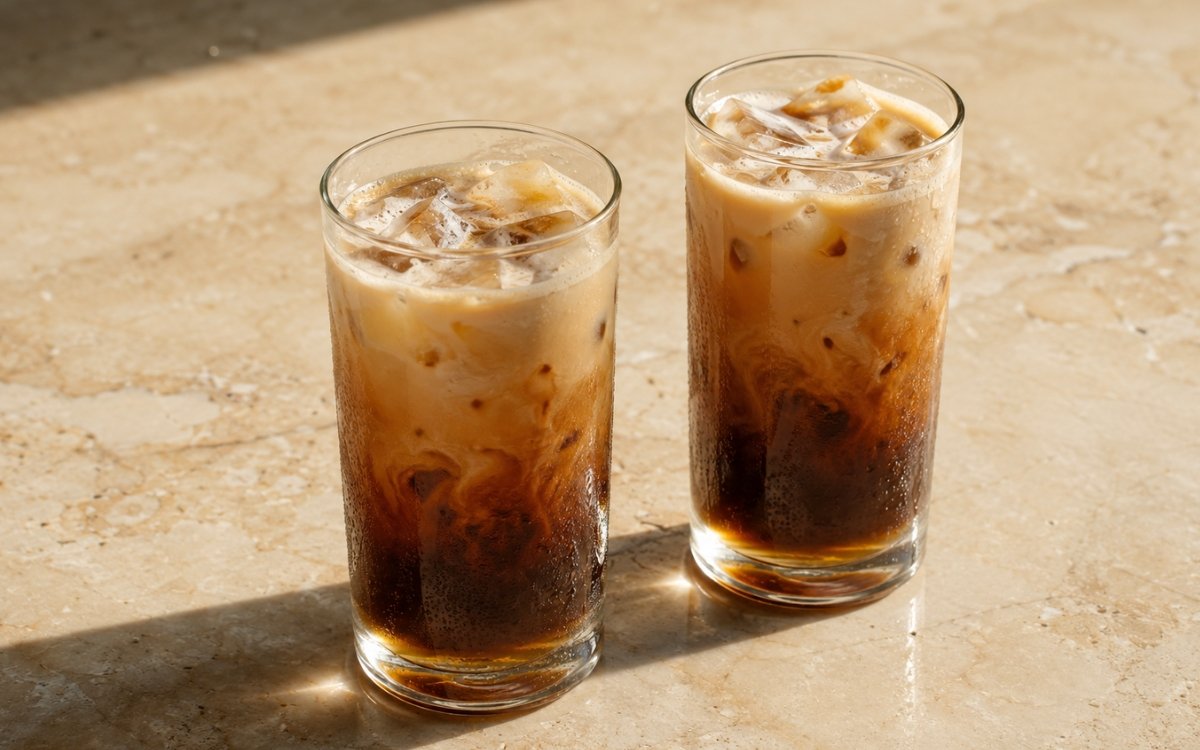
- Pour 60ml cold almond milk into each glass. Pour slowly over the ice so it creates soft pale swirls through the dark cold brew before mixing. The drink should look mostly dark coffee with a lighter almond milk cloud moving through it. If it turns pale beige like a latte, there is too much almond milk. Pouring slowly over the ice, rather than directly into the honey-sweetened coffee, lets the ice slow and redirect the almond milk's descent — that controlled fall through the glass is what produces the soft, cloud-like swirling this drink's presentation depends on, rather than the two liquids simply blending on contact.
Serve
- Serve immediately. Stir before drinking if desired. The finished drink should taste like smooth cold brew first, then honey, then a light almond milk finish. The almond milk should soften the edges, not bury the coffee. This flavour ordering functions as a genuine diagnostic for the drink's proportions — if the almond milk registers as the dominant note, that signals too much has been added relative to the coffee's own strength.
Notes
Diluting the honey into a proper syrup before it ever touches the coffee deserves to be understood as the single most consequential technique in this recipe, given how directly it determines whether the finished drink tastes evenly sweetened. Honey's thick, viscous nature means it resists dissolving quickly even when stirred directly into a cold liquid — undiluted honey added straight to cold brew would largely sink and pool at the bottom rather than integrating, leaving the coffee above tasting flat while the bottom few sips turn unpleasantly syrupy.
Stirring the diluted honey syrup fully into the coffee before the almond milk is introduced protects the drink from a genuine, easily overlooked failure mode. Sweetness added only after every other component is already in the glass has to travel through and around ice, almond milk, and coffee all at once to distribute evenly — a considerably less reliable process than simply stirring it into the plain coffee base first, while there's nothing else in the way.
The instruction to pour the almond milk slowly, specifically over the ice rather than more directly, reflects the same physical principle used throughout this collection's other layered iced coffee drinks. The ice acts as a genuine obstacle that redirects and slows the falling liquid, producing visible soft swirls and clouds rather than an immediate, uniform blend — that visual effect simply doesn't happen with a fast, direct pour.
Keeping the almond milk quantity genuinely restrained, rather than adding more for a milder result, is worth respecting as a defining boundary of this specific drink rather than a flexible preference. The recipe's own closing note draws an explicit distinction between this drink and an iced almond latte — the two are meant to be genuinely different in character, with coffee remaining clearly dominant here rather than almond milk taking over as the drink's main body.