Ingredients
Method
Make the Tzatziki First
- Grate the cucumber on the large holes of a box grater and transfer to a clean kitchen cloth. Squeeze firmly to remove as much liquid as possible — this step is non-negotiable for tzatziki that is thick enough to spoon rather than pour. Combine the squeezed cucumber with Greek yogurt, minced garlic, lemon juice, olive oil, fresh dill, fresh mint, and salt in a medium bowl. Stir until fully incorporated. Cover and refrigerate immediately. Tzatziki improves significantly with at least 20–30 minutes of resting time as the garlic and dill infuse the yogurt — making it first gives it maximum time to develop flavor.
Prepare the Turkey Burger Mixture
- Tear the crustless bread into small, rough pieces and place in a large mixing bowl. Pour the milk over the bread and allow it to soak for 3–5 minutes, pressing occasionally with your fingers, until the bread has absorbed all the milk and has a soft, wet paste consistency — this is the panade, the Italian meatball technique that makes these burgers extraordinarily moist. The panade creates steam pockets within the patty during cooking, keeping the ground turkey from drying out despite being a lean protein. Grate the onion directly over the soaked bread, then squeeze the grated onion between your palms to remove excess moisture before adding — this prevents the mixture from becoming too wet to hold together. Add the ground turkey, grated garlic, all fresh herbs, all dried herbs, salt, pepper, and red pepper flakes on top of the panade. Mix with your hands using a gentle folding motion — thorough enough to distribute everything evenly but not so aggressive that you compact the mixture, which makes dense, tight patties. The mixture should be soft and slightly sticky.
Shape and Chill the Patties
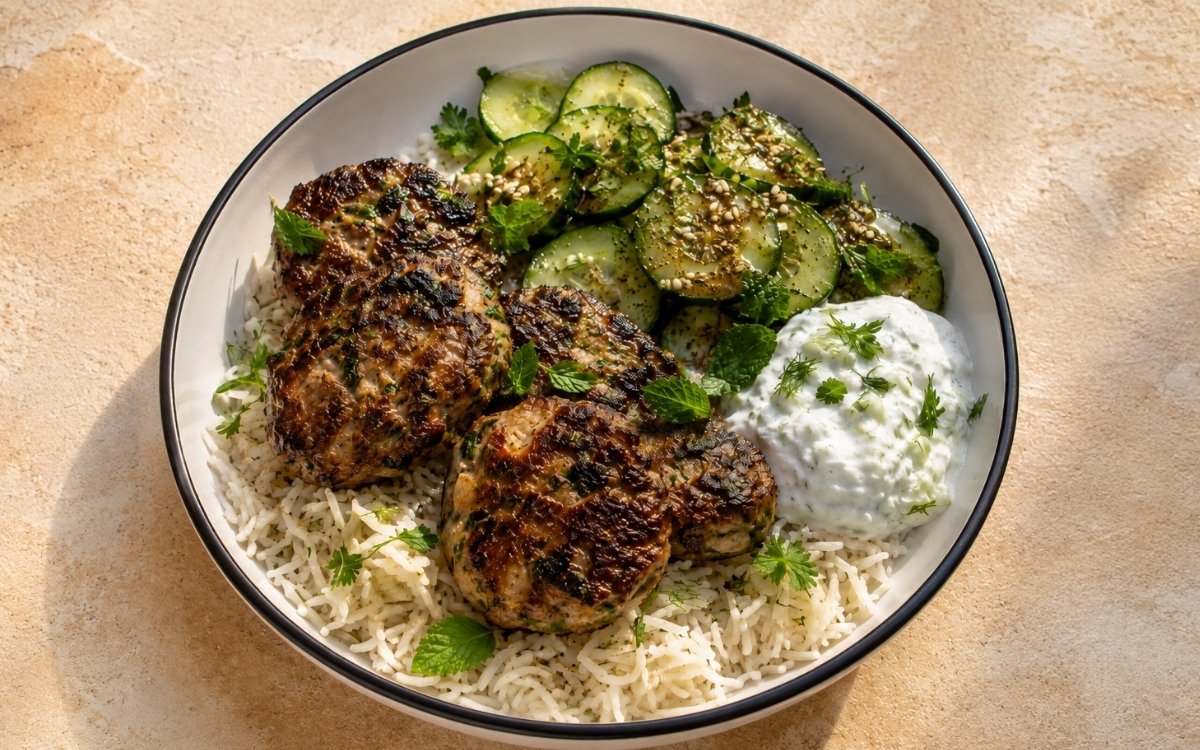
- Divide the mixture into 12 equal portions — approximately 75–80g each. Roll each portion gently between lightly oiled palms into a smooth ball, then flatten slightly into a thick disc approximately 2cm high and 7cm across. The thicker shape compared to standard hamburger patties serves two purposes: it keeps the interior moist during cooking, and it produces the rounded, meatball-like appearance visible in the finished dish. Place shaped patties on a plate or tray, cover, and refrigerate for 10–15 minutes while preparing the remaining components. Chilling firms the mixture and helps the patties hold their shape during cooking.
Start the Buttery Rice
- Rinse 240g of rice under cold running water in a fine-mesh strainer for 1–2 minutes until the water runs clear. In a medium saucepan over medium heat, melt 36g of butter until foaming. Add the drained rice and stir constantly for 2–3 minutes until the grains are coated in butter and some begin to turn lightly golden — this toasting step is what gives the rice its characteristic nutty, savory depth. Add 480ml of chicken stock or water, salt, pepper, and the bay leaf. Stir once, bring to a rolling boil, then reduce heat to low, cover tightly, and simmer for 15 minutes without lifting the lid. Remove from heat and rest covered for 5 minutes. For the full technique and tips, visit the Fluffy Butter Rice recipe.
Prepare the Za'atar Cucumber Salad
- While the rice cooks, slice the cucumbers as thinly as possible on a mandoline — ideally 1–2mm thick. The mandoline is not optional for this dish; hand-sliced cucumbers at this thickness are almost impossible to achieve consistently with a knife, and the thin, translucent slices are part of what gives the salad its delicate, voluminous character. If you do not own a mandoline, use the thinnest knife slice you can manage. In a large bowl, combine the cucumber slices with olive oil, lemon juice, lemon zest, Za'atar, salt, and black pepper. Toss gently to coat every slice. Za'atar — the Middle Eastern spice blend of dried thyme, sumac, sesame seeds, and herbs — adds earthy, tangy, sesame complexity that transforms what would be a simple cucumber salad into something genuinely distinctive. Allow to sit for 5 minutes before serving so the cucumbers soften slightly and release their juice into the dressing.
Cook the Turkey Patties
- Heat olive oil in a large, wide skillet over medium-high heat. When the oil is hot and shimmering, add the patties with at least 2cm space between them — do not crowd the pan. Crowding drops the pan temperature and causes the patties to steam rather than sear, preventing the golden, caramelized crust visible in the dish. Cook without moving for 3–4 minutes until a deep golden-brown crust has formed on the bottom. Flip carefully and cook for another 3–4 minutes on the second side. The internal temperature should reach 74°C (165°F). If the patties are browning too fast before cooking through, reduce heat to medium and cover the pan for the final 2 minutes to finish with gentle steam heat.
Assemble and Serve
- Serve family-style or in individual bowls: a generous portion of buttery rice as the base, three patties per person, a mound of Za'atar cucumber salad alongside, and a generous spoonful of tzatziki. Finish the tzatziki with a drizzle of olive oil and a pinch of extra Za'atar or dried dill.
Notes
The panade (soaked bread and milk) is the single most important technique in this recipe. Ground turkey at 15% fat is a significantly leaner protein than the beef or pork typically used in Italian meatballs — without the panade, the patties would cook to a dry, dense, crumbly texture that no amount of seasoning can compensate for. The bread and milk create a physical moisture reservoir within the patty that releases steam during cooking, keeping the interior juicy despite the lean protein content.
Grating the onion rather than chopping it is another essential technique. Finely chopped onion pieces do not fully cook through in the brief time a turkey patty spends in the pan, leaving crunchy, raw-tasting pieces throughout. Grated onion breaks down into a wet pulp that distributes invisibly throughout the mixture, contributing onion flavor and moisture to every bite without any detectable texture.
Za'atar quality varies considerably between commercial blends. A high-quality Za'atar should contain dried thyme, ground sumac, toasted sesame seeds, dried marjoram, and salt — the sumac's tartness is what makes it distinctive. A cheap Za'atar blend may lack sumac or use very little of it, producing a flatter, less complex result. Look for a Middle Eastern brand rather than a generic supermarket version.
The tzatziki recipe produces a thick, spoonable sauce — intentionally thicker than restaurant versions, which are often thinned for cost reasons. Full-fat Greek yogurt and thoroughly squeezed cucumber are non-negotiable for this consistency.