Ingredients
Method
Make the Marinade and Marinate the Chicken
- In a medium bowl, combine the fine sea salt, garlic powder, onion powder, black pepper, smoked paprika, olive oil, and full-fat Greek yogurt. Mix together until completely uniform — the yogurt, oil, and spices should form a thick, cohesive, deeply coloured paste with no dry spice pockets remaining. The yogurt is not a casual addition and its inclusion is worth understanding. Full-fat Greek yogurt contains lactic acid — the same mild acid used in buttermilk marinades — that gently denatures the proteins at the chicken's surface during marinating, breaking down some of the tighter muscle fibre structures and creating a more tender, more yielding result than an oil-and-spice marinade alone produces. More practically for grilling specifically, the yogurt's proteins and sugars caramelise at high heat and produce a more deeply developed char than an uncoated piece of chicken — the yogurt acts as an additional Maillard reaction substrate, amplifying the browning and crust formation that the grill's direct heat initiates. Add the chicken thighs to the marinade bowl and turn each piece repeatedly to coat every surface completely — including the folds and inner surfaces of each thigh. Press the marinade into the surfaces firmly. Allow to marinate at room temperature for a minimum of 30 minutes. For deeper flavour penetration and more pronounced tenderness, cover and refrigerate for up to 24 hours. The overnight version is measurably better — the lactic acid has time to work progressively deeper into the meat and the spices penetrate beyond the surface layer.
Make the Hot Honey
- The hot honey is infused rather than simply mixed — the process takes 15 minutes of passive time and produces a fundamentally different result from simply combining the ingredients cold. In a small saucepan, combine the honey and butter over the lowest possible heat. Warm gently until the butter is completely melted and the honey has thinned to a pourable, slightly runny consistency — do not exceed 35–40°C. Heat above this threshold begins caramelising the honey's sugars before the glaze reaches the chicken, which alters both the flavour and the behaviour of the finished glaze. Add the chili flakes to the warm honey-butter mixture and allow to infuse for 10–15 minutes at this gentle temperature — the warmth opens the cell structure of the dried chili flakes and allows the fat-soluble capsaicin and aromatic compounds to migrate into the honey and butter far more completely and quickly than they would at room temperature. The infused honey will deepen in colour and the chili aroma will become more pronounced as the infusion progresses. After 10–15 minutes, add the vinegar-based hot sauce and stir to combine. The hot sauce adds a secondary acid-heat dimension — the vinegar's brightness contrasts with the honey's sweetness and the chili flakes' deep, slightly earthy heat, producing a hot honey with more complexity than either element alone. The butter adds smooth richness that helps the glaze adhere to the chicken surface and prevents it from running off before it has caramelised. Keep warm on the lowest possible heat until ready to use.
Prepare the Grill with Two Heat Zones
- This recipe requires a two-zone fire — a setup with a hot direct-heat zone for initial searing and char development, and a cooler indirect-heat zone for glazing. On a charcoal grill, bank all the coals to one side for direct heat and leave the other side coal-free for indirect. On a gas grill, set all burners to high until fully preheated, then reduce one side to medium-low or off for the indirect zone. Allow the grill to preheat for 10–15 minutes until the grates are genuinely hot — hot enough to produce a visible hiss when a drop of water contacts the grate surface. The two-zone setup is the critical technique decision for this recipe: the direct zone produces the char and grill marks through intense, direct radiant and conductive heat; the indirect zone provides a controlled, lower temperature environment where the hot honey glaze can be applied and caramelised without burning. Honey's high sugar content burns extremely easily at direct-heat grill temperatures — applying the glaze over direct heat would char the honey to black bitterness before it can caramelise properly. The indirect zone provides just enough heat to caramelise the honey's sugars without pushing them past the caramelisation threshold into burnt territory.
Remove the Chicken from Refrigerator
- If the chicken was marinated in the refrigerator, remove it 30–60 minutes before grilling and allow it to approach room temperature. Cold chicken straight from the refrigerator has a large temperature gradient between its cold interior and the ambient surface — when this cold mass contacts the extremely hot grill surface, the surface chars and dries significantly before the interior reaches the correct internal temperature. Room-temperature chicken cooks more evenly from surface to centre, producing a better-developed char alongside a properly cooked interior.
Grill Over Direct Heat for Char and Grill Marks
- Place the marinated chicken thighs on the hot direct-heat grate. Resist the urge to move them immediately — leave undisturbed for 4–5 minutes before lifting. The char and grill marks develop only through sustained, uninterrupted contact between the marinated surface and the hot grate. Moving the chicken before the crust has set tears the developing char and prevents the clean grill mark lines from forming. At the 4–5 minute mark, lift one edge of a thigh gently with tongs — if it releases cleanly from the grate, the first side is ready. If it sticks and resists, it needs another 60–90 seconds. The first side should show deep, dark grill marks with a charred, caramelised surface and the yogurt marinade visibly darkened and set. Flip all thighs and cook the second side for 3–4 minutes. Check the internal temperature with an instant-read thermometer at the thickest point — the goal at this stage is to reach approximately 68–70°C, approaching but not yet at the final target of 74°C. The remaining cooking will happen on the indirect zone during the glazing stage. If some thighs have reached 70°C and others are lower, transfer the more developed ones to the indirect zone first and allow the others to continue on direct heat briefly.
Transfer to Indirect Heat and Begin Glazing
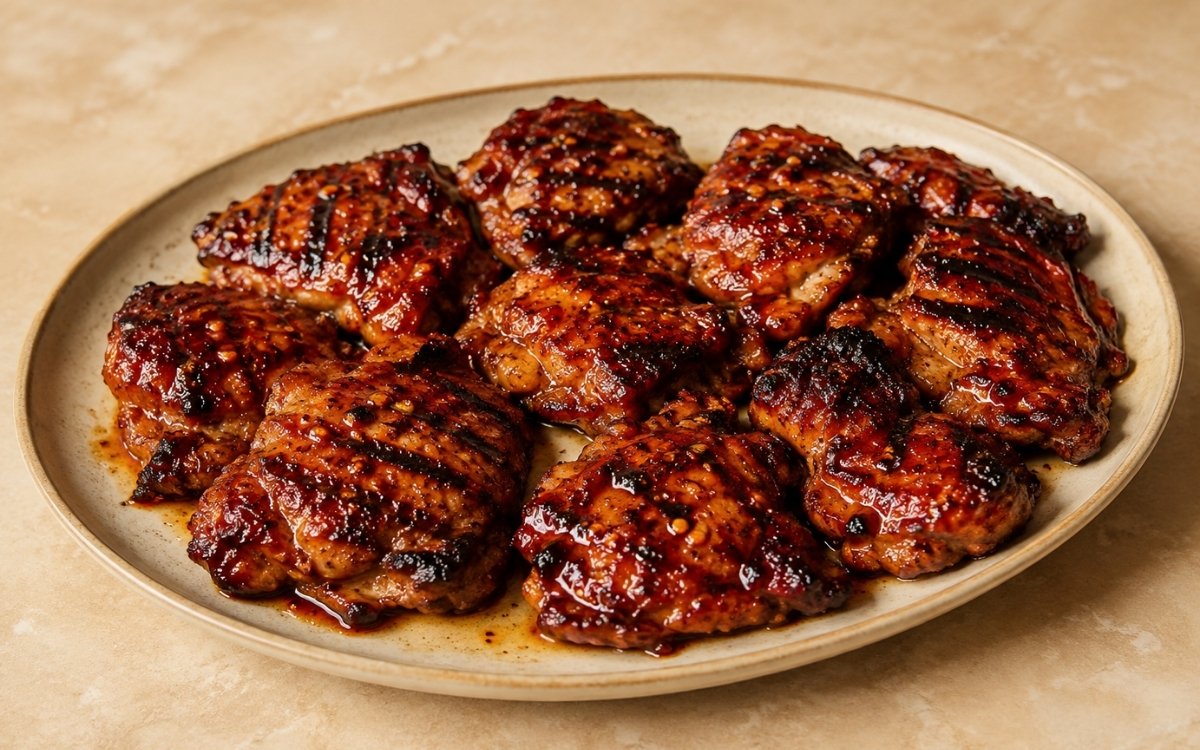
- Move all charred thighs from the direct zone to the indirect zone of the grill. Using a cooking brush, apply a generous coat of the warm hot honey glaze over the top surface of each thigh. Close the grill lid and allow the glaze to caramelise for 2–3 minutes. Open the lid and flip each thigh, apply another generous coat of hot honey to the newly exposed surface, close the lid, and allow to caramelise for another 2–3 minutes. Repeat this flip-and-glaze cycle until all the hot honey has been used across all the thighs — typically 3–4 rounds total. With each successive round of glazing, the chicken surface builds a progressively deeper, more layered caramelised honey crust — the first coat penetrates slightly into the charred surface, the second builds on top of the first, and the third and fourth produce the characteristic glossy, sticky, deeply red surface that makes hot honey chicken visually striking. Check the internal temperature after the third round of glazing — it should be approaching or at 74°C. Remove from the grill immediately when the temperature confirms 74°C and the surface is glossy, sticky, and deeply caramelised. Rest for 3–5 minutes before serving.
Notes
The yogurt marinade's contribution to grilling is specific and worth elaborating beyond the tenderness benefit. When yogurt-marinated chicken makes contact with a hot grill grate, the yogurt's proteins set almost immediately on the outermost surface, forming a thin, set protein shell that holds the spices and yogurt solids against the chicken surface as the char develops beneath it. This set protein layer is what prevents the spice crust from simply falling off the chicken into the grill as it often does with an oil-only marinade. The result is a spice-infused char that adheres completely to the chicken surface throughout the grilling process. The same principle explains why Indian and Middle Eastern yogurt-marinated preparations — tandoori chicken, shawarma, chicken tikka — all use yogurt as the marinade base for grilling and high-heat cooking.
The hot honey infusion at low temperature is a deliberate choice over simply warming the honey briefly. At 35–40°C for 10–15 minutes, the chili flakes' cell walls are gently softened by the heat and the fat-soluble capsaicin compounds migrate progressively into the surrounding butter and honey. The result after 15 minutes of infusion is a honey that carries the chili's heat, fruitiness, and aromatic depth evenly throughout rather than delivering concentrated spice only when a chili flake is encountered directly. Cold honey with chili flakes added has sharp, uneven heat distribution; properly infused honey has even, pervasive warmth in every drop.
Vinegar-based hot sauce rather than sriracha or other thicker, sweeter hot sauces is specified for a specific reason. The acid in Frank's or Tabasco cuts through the honey's sweetness and adds a sharp, tangy contrast that prevents the glaze from tasting one-dimensionally sweet and spicy. The fermented pepper character of a vinegar-based sauce also adds a secondary, complex flavour dimension that plays specifically well with caramelised honey. Sriracha's garlic and sugar would produce a different, more muted result.