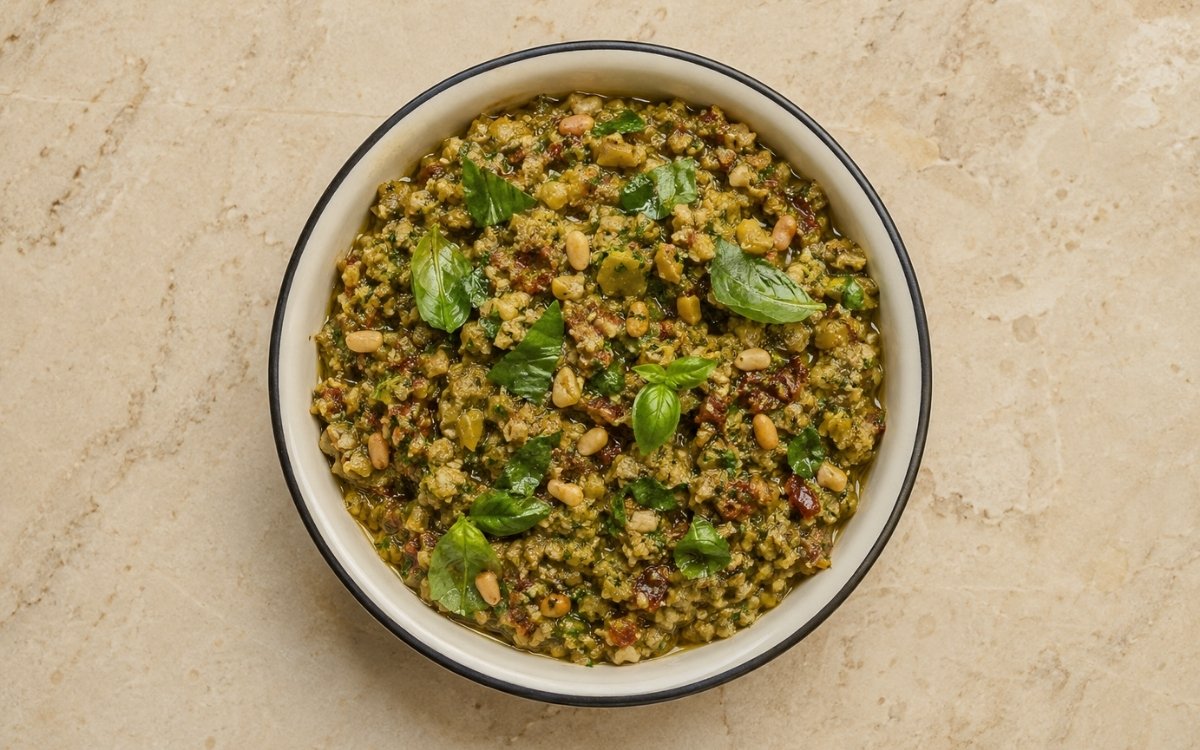
Ingredients
Method
Toast the Pine Nuts
- Place the 30g of pine nuts in a dry skillet over medium-low heat — no oil. Toast, stirring frequently, until the nuts are clearly and evenly golden across their surfaces and smell of warm, roasted butter — typically 4–6 minutes. The medium-low heat rather than medium or high is specifically important: pine nuts are small and thin and go from pale to correctly golden to burnt in a very narrow window at higher temperatures. Stirring frequently ensures every nut contacts the pan surface equally rather than the bottom layer burning while the top layer remains raw. Under-toasted pine nuts — pale, barely coloured — taste of almost nothing and contribute only fat to the finished tapenade rather than the specific nutty, slightly sweet depth of correctly toasted ones. Transfer immediately to a plate when golden — they continue toasting from residual pan heat for 30–60 seconds if left in the pan. Allow to cool completely before adding to the food processor; warm pine nuts soften slightly and produce a slightly paste-like texture rather than a distinct, toasted piece in the finished spread.
Drain the Olives, Capers, and Sun-Dried Tomatoes
- Drain the 450g of green olives through a colander, pressing lightly to expel residual brine. Drain the 25g of capers through a fine-mesh sieve and shake firmly. Drain the 45g of sun-dried tomatoes and press between paper towels to remove the oil — sun-dried tomatoes packed in oil are specifically preferred for their soft, pliable texture and the way their sweetness integrates into the tapenade, but their coating oil must be largely removed so it does not make the finished spread oily and loose rather than rich and concentrated. Allow all three to drain for at least 5 minutes before processing. The choice of green olive variety directly determines the finished tapenade's character. Castelvetrano olives — large, bright green, buttery, mild, and very fruity — produce the mildest, most approachable tapenade with the least bitterness. Picholine olives produce a firmer, more herbal, more classically French result. Cerignola olives are very large and mild with a clean, slightly sweet flavour. Sicilian green olives tend toward a more assertive, slightly spicier character. Any of these varieties produces a significantly more complex and flavourful tapenade than the standard mild marinated green olives available at most supermarket olive bars.
Pulse the Main Ingredients
- Add the 1 small garlic clove, drained green olives, drained capers, drained sun-dried tomatoes, cooled toasted pine nuts, ½ tsp of oregano, ½ tsp of black pepper, pinch of chili flakes, 1 tsp of lemon zest, and 1 tbsp of lemon juice to the food processor bowl. The garlic is specifically a small single clove — green tapenade's flavour profile is lighter and more delicate than black olive tapenade's, and an aggressively garlicky version overpowers the basil's aromatic character that is one of the recipe's primary flavour contributions. Pulse in short, controlled bursts of 1–2 seconds each — pausing between each burst to assess texture. Continue pulsing until the mixture is finely chopped and cohesive, with every piece reduced to approximately 3–5mm, but with visible texture and identifiable components remaining. Stop before it becomes smooth — over-processed tapenade loses all textural interest and the toasted pine nuts disappear into the surrounding paste rather than providing their specific pleasantly crunchier presence.
Add the Basil at the End of Processing
- Add the 20g of fresh basil leaves to the processor on top of the pulsed olive mixture. Pulse 5–6 times briefly — just enough to break the basil leaves into small, distributed pieces throughout the mixture without fully breaking them down. This late addition is the sequence decision that keeps the basil green and fresh in the finished tapenade. Basil processed from the start with the olives undergoes both physical and oxidative breakdown — the blades bruise the cells and release polyphenol oxidase, which rapidly browns the leaf tissue from bright green to dull, dark greenish-brown. Brief pulsing at the end keeps the cells largely intact, preserving the vivid green colour and the fresh, specifically aromatic character of unbroken basil. Assess the basil distribution after 5 pulses — the leaves should appear as small, bright green pieces throughout rather than as a few large whole leaves or as a smooth green paste.
Add the Olive Oil
- With the processor running at low speed, drizzle in the 50ml of extra-virgin olive oil in a steady, thin stream. Stop and assess: the tapenade should be glossy, slightly loosened, and spreadable. If the texture is too dense or the tapenade appears dry, add additional olive oil in 1 tbsp increments up to the 70ml maximum, pulsing briefly after each addition to assess the change.
Add Parmesan If Using
- If including the optional 20g of finely grated Parmesan, do not add it to the food processor. Transfer the pulsed tapenade to a bowl and fold the Parmesan through by hand using a rubber spatula — folding rather than stirring vigorously, turning the mixture over itself until the Parmesan is evenly distributed. Parmesan added to the food processor blends into the surrounding mixture and produces a heavier, slightly denser texture that reduces the fresh, light quality of the green tapenade. Folded in by hand, it remains as a seasoning element — providing its sharp, salty, umami-rich character in distributed pockets rather than as a uniform background note.
Taste and Adjust Without Salt First
- Taste the assembled tapenade before any salt is considered. The green olives, capers, sun-dried tomatoes, and optional Parmesan together provide significant sodium — a tapenade made from these ingredients rarely requires additional salt, and salt added before tasting invariably produces an over-salted result. Adjust each dimension specifically: if the brightness is insufficient, add additional lemon juice in 5ml increments. If the freshness needs lifting, add 3–4 additional basil leaves and pulse very briefly. If the texture is too dense or the saltiness too prominent, additional olive oil rounds and loosens. If more heat is preferred, add additional chili flakes and fold through. Only if the finished tapenade tastes genuinely flat despite these adjustments should a very small amount of fine salt be considered.
Rest and Finish
- Allow the tapenade to rest at room temperature for 15–20 minutes before serving. During this rest the basil's aromatic volatile oils distribute more evenly through the olive oil base, the lemon zest's citrus compounds bloom into the surrounding fat, and the toasted pine nuts' roasted character integrates with the green olive's fruitiness into a unified, cohesive flavour profile. A scattering of fresh basil leaves and a thin drizzle of good olive oil over the surface before serving provides the finishing visual and aromatic brightness.
Notes
The basil addition sequence — last, briefly — is the technique decision that most distinguishes a vibrantly green, fresh-tasting green olive tapenade from the dull, brown-green version that results from processing basil from the start. The key compound is polyphenol oxidase — the enzyme present in basil's cells that, when released by bruising or cutting, rapidly oxidises the chlorophyll and phenolic compounds responsible for the leaf's green colour. In the food processor, continuous high-speed pulsing releases this enzyme from every cell simultaneously and produces the characteristic browning within 30–60 seconds of processing. Brief end-addition pulsing breaks only the largest cells while leaving most intact — the enzyme is released only minimally, and the short time between final processing and serving does not allow significant browning to develop.
The combination of pine nuts, sun-dried tomatoes, basil, capers, and green olives produces a flavour composition that is specifically Italian rather than Provençal in character — closer to a Sicilian olive and herb spread than to the classic French tapenade. The sun-dried tomatoes' sweet concentration against the olive's clean fruitiness and the basil's anise-like freshness is a specifically Mediterranean Italian combination that makes this tapenade's flavour profile immediately recognisable as distinct from its black olive counterpart.