Ingredients
Method
Prepare the Strong Coffee
- Brew strong coffee, then chill it completely. If using espresso, brew 120ml espresso total, then mix it with 180ml cold water and chill briefly. The coffee must taste slightly stronger than you would normally drink it. Ice will dilute it, and weak coffee makes a flat, watery slushie. Because a substantial amount of ice is about to be blended directly into this base, the coffee needs to start with enough concentrated strength to survive that dilution and still taste like real coffee once it's fully icy and blended.
Sweeten the Coffee Base
- Stir the simple syrup and salt into the chilled coffee. Use 30ml syrup total for a balanced coffee-forward version or 40ml for a sweeter café-style slushie. Sweeten the coffee before blending. Sugar or honey added later does not dissolve evenly in a frozen slush and leaves grainy or syrupy pockets. Once ice is blended into the mixture, everything present becomes suspended within that icy, semi-frozen structure — a solid sweetener introduced at that stage has nowhere near the same opportunity to dissolve fully that it would in the still-liquid coffee, which is exactly why sweetening happens here, before any blending begins.
Blend the Slushie
- Add the sweetened chilled coffee, cold milk, and 250g ice to a blender. Blend in short pulses until the mixture becomes thick, icy, and pourable. Add the remaining 50g ice only if the texture is too loose. Stop while the drink still has a visible crushed-ice texture. Do not blend it completely smooth. A frozen coffee slushie should be icy and refreshing, not a creamy frappé shake. Pulsing in short bursts rather than running the blender continuously gives real control over how finely the ice breaks down — continuous blending would quickly push past the coarse, granita-like texture this drink depends on and into something closer to a smooth, uniform slush.
Adjust the Texture
- Check the consistency. If it is too thick to pour, add a small splash of cold coffee or milk. If it is too thin, add a few more ice cubes and pulse briefly. The finished texture should mound slightly in the glass but still be drinkable through a straw after a minute or two. This texture target — able to hold a slight mound while still remaining sippable — is a genuine middle ground worth checking for directly rather than assuming from a fixed blending time, since ice size and blender power both affect how quickly that consistency is reached.
Serve
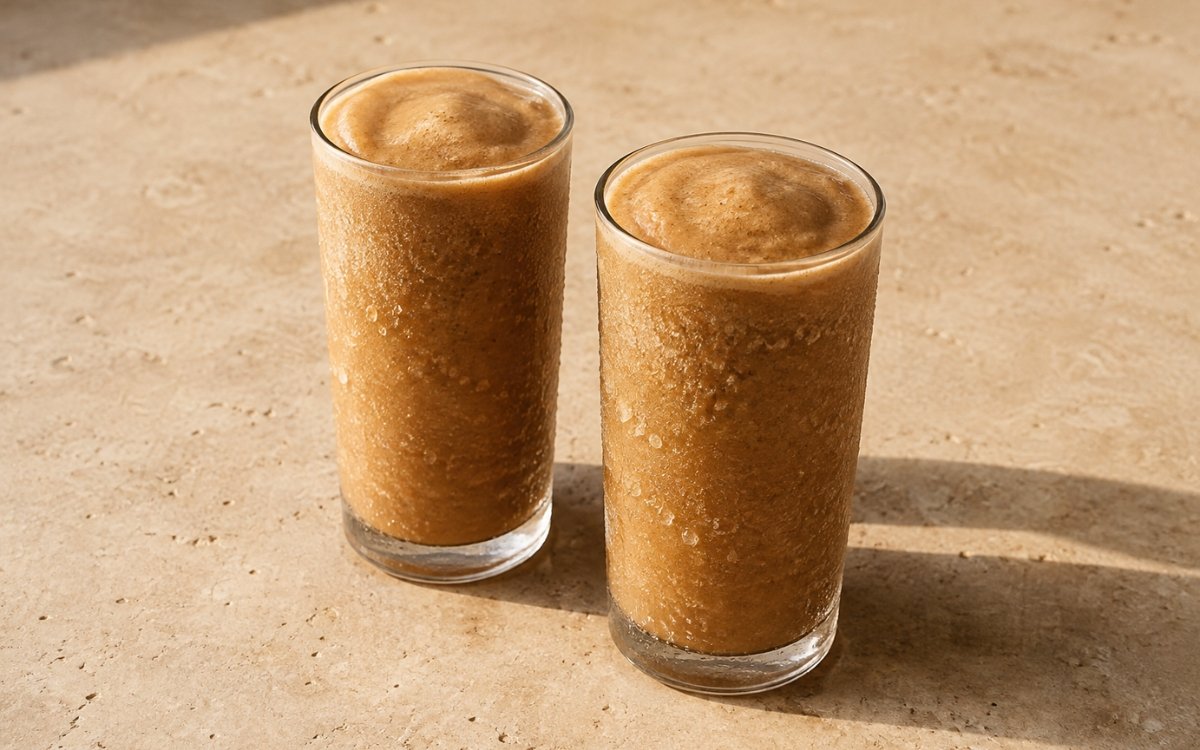
- Pour immediately into 2 glasses, about 250ml each. Serve right away. This drink has a short perfect window. It should look frozen, dark coffee-brown, and icy. If it sits too long, it separates into coffee liquid at the bottom and foam at the top. A freshly blended slushie's ice crystals begin melting and settling the moment blending stops, and that separation into liquid and foam is a genuinely fast process — serving immediately is what catches the drink at its intended, properly icy texture.
Notes
Sweetening the coffee before any ice is blended in deserves real attention, since it's the step most directly responsible for whether the finished slushie tastes evenly sweet or leaves unpleasant pockets of undissolved sweetener. Once ice enters the mixture and the whole thing takes on a semi-frozen, blended structure, any solid sweetener added at that point has considerably less opportunity to fully dissolve — the syrup needs to already be part of the liquid coffee before that structural change happens.
The short-pulse blending approach is worth understanding as the technique responsible for this drink's specific identity, distinguishing it clearly from a smooth, creamy frappé. Continuous blending very quickly breaks ice down past the coarse, crystalline texture a proper slushie or granita depends on, producing instead a uniformly smooth slush that's lost the textural character this recipe is specifically built around. Pulsing gives real, deliberate control over exactly how far that breakdown goes.
Starting with coffee brewed genuinely stronger than normal drinking strength addresses a straightforward but easily underestimated dilution problem. A substantial quantity of ice is about to be blended directly into this coffee, and that ice inevitably melts and dilutes the mixture further as it's processed — coffee that started at normal strength simply doesn't have enough concentration left to taste like real coffee once that dilution has happened.
The drink's genuinely short serving window deserves to be taken seriously rather than treated as a minor inconvenience. A freshly blended slushie's structure is inherently unstable once it leaves the blender, with ice crystals beginning to melt and separate from the liquid almost immediately — every step in this recipe, from the strong coffee base to the careful sweetening to the controlled blend, is calibrated to produce a drink meant to be served and enjoyed right away, not one built to hold its texture over time.