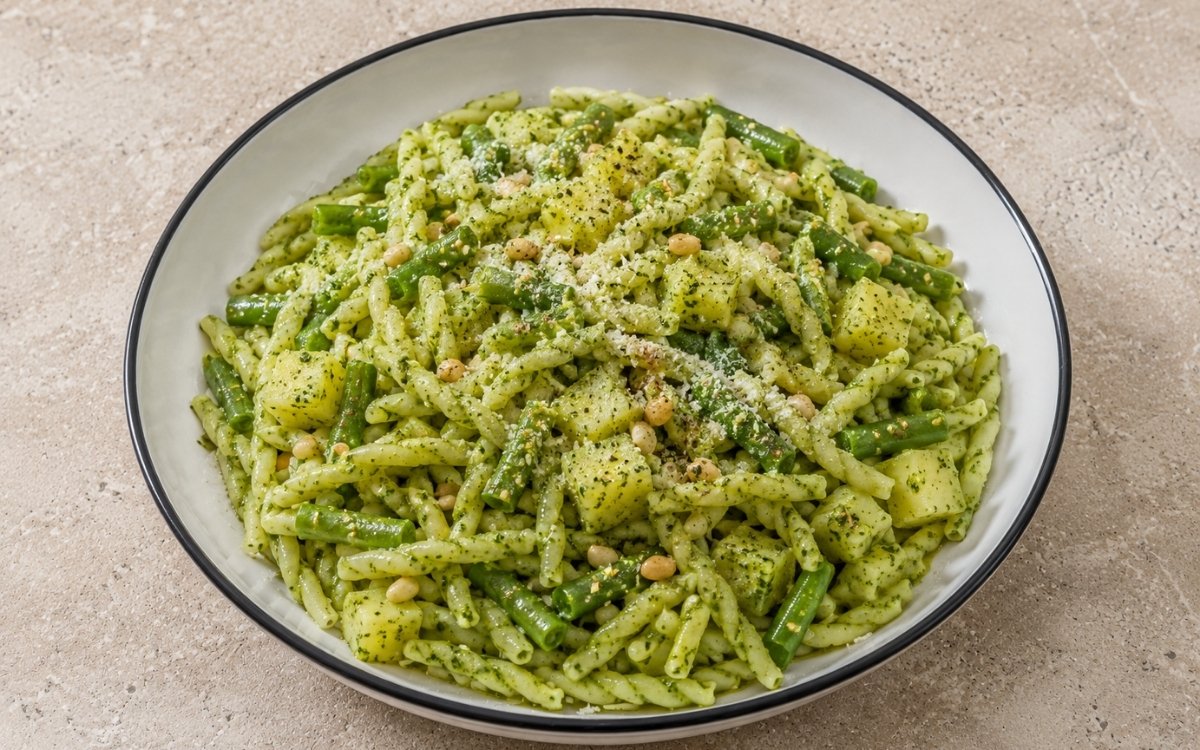
Ingredients
Method
Cook the Vegetables in the Pasta Water
- Bring a large pot of water to a full rolling boil and add salt generously until it tastes assertively of the sea — the same water will be used for the pasta after the vegetables, meaning it will carry both salt and the starch from the potato cubes into the pasta cooking, enriching it further. Add the 120g of diced potato cubes and cook for 5 minutes — they need the head start because their density requires longer cooking to become tender than the green beans. At the 5-minute mark, add the 150g of green bean pieces alongside the potatoes and cook for 3 more minutes. Both vegetables should be just tender at this point — the potatoes yielding to a fork with slight resistance, the green beans tender but still holding their shape and colour without being soft or faded. Use a spider strainer or slotted spoon to transfer both vegetables to a bowl, reserving all the cooking water in the pot. Do not drain the pot — this water, now enriched with potato starch and seasoned with salt, is the pasta cooking water and subsequently the pasta water reserved for the sauce.
Toast the Pine Nuts
- If the pine nuts are not already toasted, place them in a dry skillet over medium-low heat and toast for 2–3 minutes, stirring or shaking continuously, until they show an even, light golden colour and smell distinctly nutty. Pine nuts contain a very high proportion of polyunsaturated fat that oxidises quickly at higher temperatures — the line between toasted and burnt is particularly short with pine nuts, and burnt pine nuts are bitter and cannot be salvaged. Remove from the heat immediately when golden and transfer to a plate to cool. Toasted pine nuts produce a noticeably more complex, more flavourful pesto than raw pine nuts — the toasting develops the nut's natural oils and produces additional Maillard-reaction flavour compounds that raw pine nuts lack.
Make the Pesto
- The pesto can be made by either the traditional mortar-and-pestle method or a food processor — the two produce slightly different results and both are excellent. The mortar-and-pestle method produces a slightly coarser, more textured pesto with more distinct flavour from the mechanical bruising action of the pestle releasing the basil's aromatic oils gradually rather than cutting them — the result has a more complex, more specifically Ligurian character. The food processor produces a smoother, more uniform pesto more quickly and efficiently. Both approaches begin the same way. Add the toasted pine nuts and the roughly chopped garlic to the mortar or processor with a pinch of salt. In a mortar, pound to a rough paste using a circular pressing motion — 60–90 seconds until the pine nuts and garlic have broken down into a coarse, sandy paste. In a food processor, pulse 6–8 times in 3-second bursts. Add half of the basil leaves. In the mortar, work the leaves into the paste using the same circular pressing motion — the salt's abrasive crystals help break the cell walls and release the chlorophyll and aromatic oils. In the processor, pulse 4–5 times. Add the remaining basil and continue until the pesto reaches a textured paste — smooth overall but with small, distinct basil and nut fragments still visible rather than a completely uniform green purée. Texture is the quality indicator: over-processed pesto loses the distinct aromatic compound contributions of each ingredient and produces a flat, homogeneous result. Transfer to a medium bowl. Stir in the 60g of Parmigiano-Reggiano and 30g of Pecorino Romano until evenly distributed. Drizzle in the 120ml of olive oil slowly while stirring continuously — the slow addition while stirring produces a partially emulsified pesto where the oil is evenly distributed rather than pooling on top. Add the 15ml of lemon juice and 2g of black pepper. Taste and adjust salt. The pesto should taste vivid, herby, nutty, and full-flavoured — the cheeses provide salt, the lemon provides brightness, and the olive oil provides the smooth, carrying richness. All ingredients should be at room temperature — cold basil bruises more readily during processing and cold cheese does not incorporate into the oil as smoothly as room-temperature cheese.
Cook the Pasta
- Return the vegetable cooking water to a full rolling boil and add the 400g of pasta. Trofie — the short, twisted Ligurian pasta shape — is the traditional format for pesto alla Genovese because its twisted form traps the pesto in its spirals, ensuring maximum sauce contact per piece. Linguine is the second most traditional format and the easiest to find outside Liguria — the long, flat format allows the pesto to coat each strand completely. Gemelli — two strands twisted together — provides excellent pesto trapping similar to trofie. Cook according to the package directions until al dente, stirring occasionally to prevent sticking. Before draining, reserve 240ml of the starchy, potato-enriched pasta water. The potato starch from the vegetable cooking step has made this water particularly starchy — more effective as a sauce emulsifier than standard pasta water. Drain.
Combine, Emulsify, and Add Vegetables
- Return the drained pasta to the pot over the lowest possible heat. Add the entire pesto and 120ml of the reserved pasta water immediately. Toss vigorously with tongs for 1–2 minutes — turning the pasta through the pesto and pasta water continuously. The tossing motion creates the emulsification that distinguishes pasta tossed with pesto from pasta simply sauced with it: the mechanical action distributes the pesto's oil into the starchy pasta water, the pasta's surface starch releases into the mixture, and the result is a creamy, coating consistency that clings to every strand rather than pooling at the bottom of the bowl. Add more pasta water in 30ml increments if the pesto appears too thick or the pasta looks dry — the correct consistency is creamy and glossy, coating the pasta without excess liquid pooling. Add the cooked potato cubes and green beans and toss gently to combine. The potato cubes, already tender, break down slightly at their edges during this gentle tossing — releasing additional starch into the sauce and adding body to the coating. The green beans distribute through the pasta. Taste and adjust — additional lemon juice if the dish needs brightness, additional salt if flat.
Serve
- Divide among four warm bowls immediately — pesto continues to oxidise and darken slightly at room temperature and the dish is most vivid green within the first 5 minutes. Drizzle a small amount of your best extra-virgin olive oil over each bowl. Add a generous crack of fresh black pepper. Bring additional finely grated Parmigiano-Reggiano to the table.
Notes
Pesto alla Genovese with potatoes and green beans — trofie al pesto con patate e fagiolini — is the canonical, traditional Ligurian preparation. The addition of potatoes and green beans is not a modern embellishment or a way to make the dish more substantial: it is the original recipe that the simplified version without vegetables is a later abbreviation of. The potatoes contribute starch to the sauce and their creamy, yielding texture contrasts with the pasta's bite. The green beans add natural sweetness and a slight vegetable freshness that the pure pasta-and-pesto version lacks. The complete three-element version is unambiguously more satisfying and more coherent as a dish than pasta-pesto alone.
The specific basil quantity — 80g, approximately 4 packed cups of leaves — is large relative to the other ingredients and produces an assertively herby, vivid-green pesto. Commercial and jarred pesto typically under-specifies basil to reduce cost, producing a pale, olive-oil-forward product that tastes less of basil than of oil and cheese. Authentic home pesto at the correct basil quantity produces a sauce that smells of fresh basil immediately and tastes of it in every bite. Use the full 80g.
Pesto should never be heated directly. Direct heat destroys the chlorophyll in the fresh basil, turning it from vivid green to olive brown within seconds, and destroys many of the volatile aromatic compounds that make fresh pesto specifically delicious. The pasta water and the pasta's own residual heat are the only heat pesto should encounter — the same off-heat or very low heat technique used for the egg emulsification in carbonara, but for completely different reasons.