Ingredients
Method
Lightly Crush the Cucumber
- Place one cucumber on a cutting board. Using the bottom of a heavy pan or pot, apply a firm but controlled downward press along the length of the cucumber — enough force to crack the flesh and produce visible splits and releases of moisture, without fully crushing the cucumber into a pulp. The visual target: a cucumber that is noticeably cracked and split, releasing juice visibly, with intact sections still present alongside the cracked ones. Chop the cracked cucumber into rough 3–5cm chunks. Add to the large pitcher. The light crush technique is the preparation's defining step. Cucumber's characteristic aromatic compounds — particularly hexanal and trans-2-nonenal — are concentrated in the outer layers and in the immediately sub-surface cells. These compounds are fat-soluble and cell-wall-bound at the cellular level, released when the cell walls are physically disrupted. A light crush ruptures the cells in the outer flesh of the cucumber, releasing these compounds into the surrounding water at the slow, progressive rate of cold infusion that produces a clean, specifically fresh cucumber water rather than an immediately intense one. A slice without crushing releases some compounds from the cut surfaces; a light crush releases significantly more from the disrupted cells throughout the outer flesh.
Optional Honey Pre-Dissolution
- If using honey, place the 15–30g in a small bowl. Add 2–3 tablespoons of warm water and stir until completely dissolved into a fluid, clear honey syrup. Never add honey directly to cold water — honey's viscosity at cold temperature is extreme, and it will settle as undissolved sticky deposits at the bottom of the pitcher rather than distributing through the water. The pre-dissolved honey syrup integrates immediately into any temperature of water. The honey is specifically optional in this preparation — and when included, at the lowest quantity that produces a barely perceptible gentle sweetness rather than the clearly sweet character of lemonade. 15g in 3 litres is 0.5g per serving: specifically present as a softness rather than as a flavour.
Build the Infusion
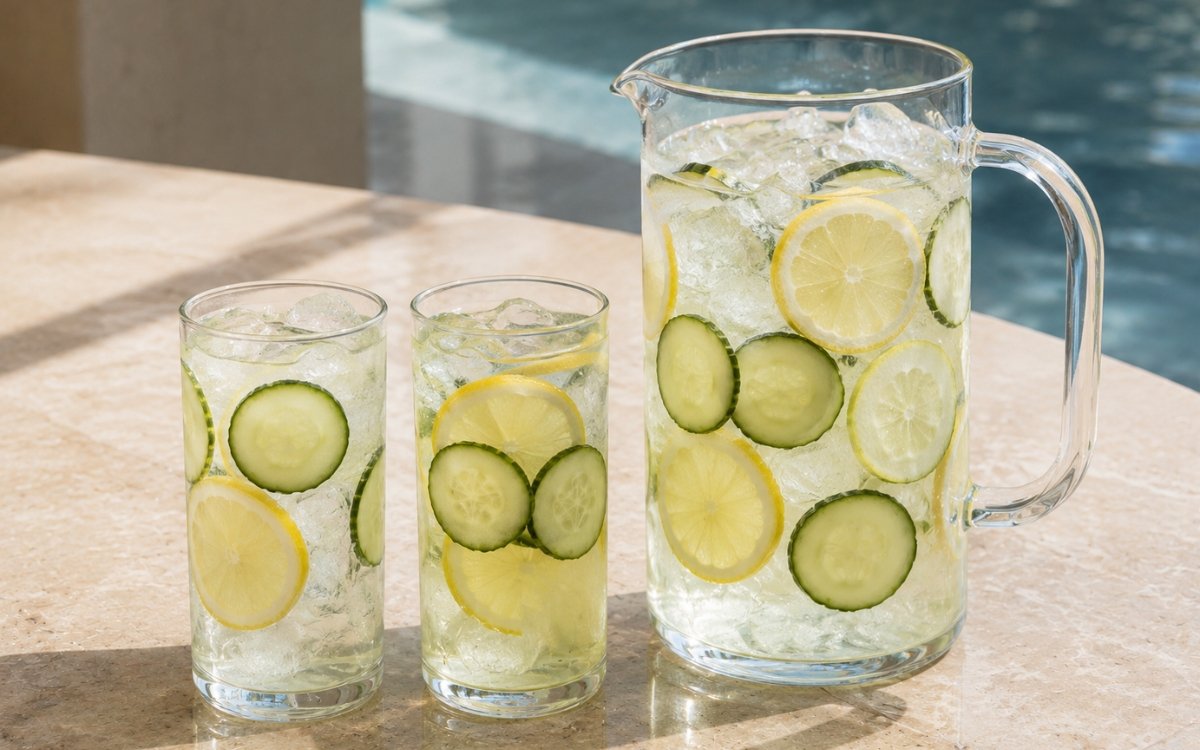
- Add the optional lemon juice, optional pre-dissolved honey, and the 1–2 pinches of fine sea salt to the pitcher with the crushed cucumber. The lemon juice at 45–60ml in 3 litres of water is approximately 15–20ml per litre — a fraction of the lemonade preparations' 240ml per 1.5 litres. This quantity is specifically calibrated for a barely perceptible brightness rather than any citrus flavour; if the finished water tastes of lemon at all, the correct response is more water rather than less lemon juice. The salt at 1–2 small pinches in 3 litres is at the most sub-threshold application in this collection — present specifically to make the water's flavour seem more vivid and clean rather than as any detectable seasoning. Pour the 3 litres of ice-cold water into the pitcher, add the thinly sliced lemons and sliced cucumbers, and stir gently once or twice — a single slow rotation rather than aggressive mixing, distributing the ingredients through the water without bruising the cucumber slices or the lemon into releasing more aggressive flavour compounds than the cold infusion would naturally produce.
Infuse, Time Carefully, and Remove
- Cover and refrigerate for a minimum of 1 hour. At 1 hour the infusion is light — a subtle, clean cucumber freshness with barely perceptible lemon; the water tastes specifically more interesting than plain water without the flavour being specifically present. At 2 hours the infusion is at the pleasant mid-point. At 4 hours it is at the maximum — the deepest, most specifically present cucumber and lemon character that the cold infusion technique will produce within the desirable range. After 4 hours, remove the lemon slices and cucumber pieces from the pitcher. This is the preparation's most important timing instruction. Beyond 4 hours the cucumber's more inner-cell compounds — particularly the slightly bitter, more intensely vegetal hexenols that extract more slowly than the pleasant hexanal and trans-2-nonenal — reach concentrations where they shift the water's character from refreshing to slightly flat and bitter. The lemon slices begin contributing pith bitterness as the pith's limonoid compounds extract progressively into the cold water. Remove everything at 4 hours for clean, specifically pleasant infused water that can then be stored for an additional 24 hours as water alone. Serve well chilled directly from the pitcher, or over ice if preferred.
Notes
Cucumber variety selection produces meaningful differences in the finished water. English cucumbers (the long, thin, seedless supermarket variety) have the thinnest skin, lowest seed content, and the most specifically clean, mild, refreshing aromatic character — the best choice for infused water. Persian cucumbers (shorter, similar thin skin) are equally appropriate. Garden cucumbers (thicker skin, more seeds, waxed in commercial production) should be peeled before use in infused water — the wax coating specifically prevents the aromatic compounds from releasing into the water, and the thicker skin releases more bitter compounds than English or Persian varieties. Waxed cucumbers are identifiable by their slightly glossy surface.
The infused water can be made in any clean container — a glass pitcher is ideal for visual appeal and easy serving. A covered glass jar refrigerated on its side maximises the surface area contact between the cucumber and lemon slices and the water, producing slightly faster infusion than an upright pitcher.