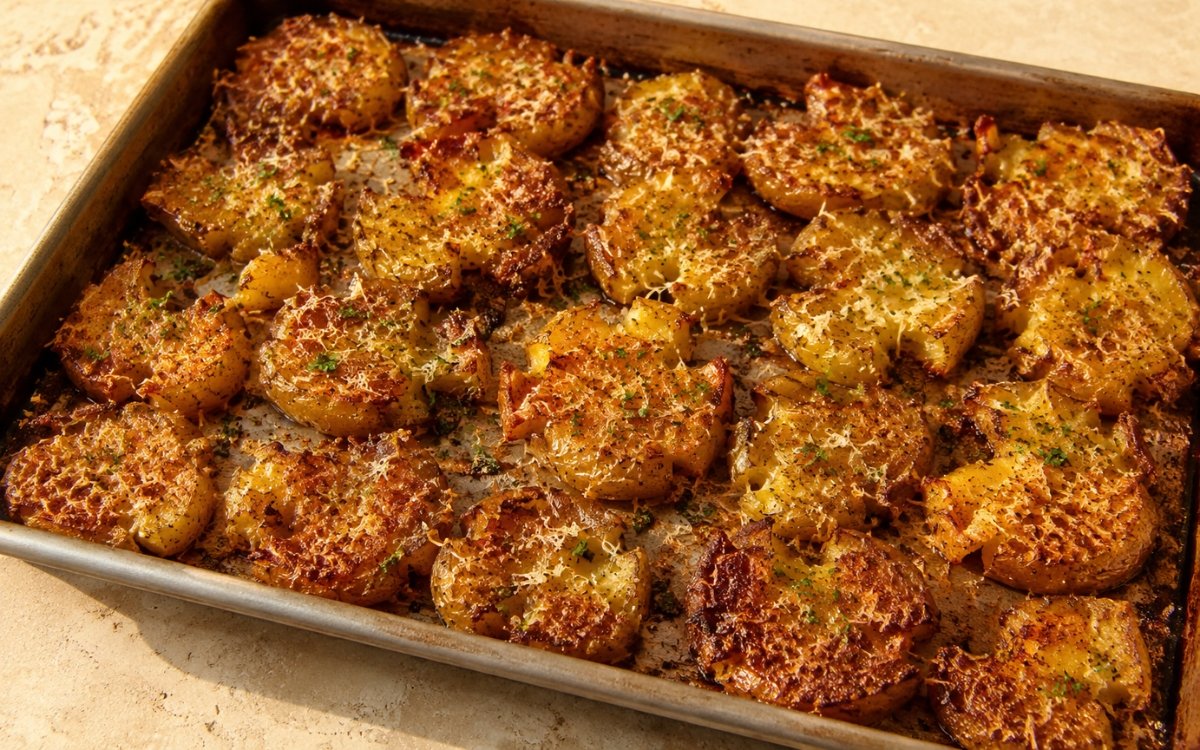
Ingredients
Method
Boil the Potatoes to the Right Doneness
- Place the potatoes in a large 4–5L pot and cover with cold water by 2–3cm. Add the 15g of salt to the cold water and stir briefly. Bring to a full boil over high heat, then reduce to a steady medium simmer. Cook for 15–20 minutes, beginning to test at the 15-minute mark by inserting a small sharp knife or skewer into the centre of the largest potato. The correct doneness for smashed potatoes is a specific and somewhat narrow window — the knife must slide in with minimal resistance, indicating the interior is fully cooked and will compress cleanly when smashed, but the potato must still hold its shape as a whole piece rather than falling apart or crumbling when lifted. A potato that is under-cooked will resist the smash, crack jaggedly rather than compressing flat, and produce a dense, slightly chalky interior. A potato that is over-cooked will collapse when smashed rather than flattening — it becomes too soft to hold the craggy, irregular shape that produces the maximum surface area for crisping. If the potatoes are genuinely different in size, remove the smaller ones as they finish and allow the larger ones to continue cooking — uniform testing of every piece ensures the whole batch is at the correct doneness simultaneously.
Drain and Steam Dry
- Drain the cooked potatoes thoroughly through a colander, shaking it firmly to remove standing water. Allow the potatoes to sit in the colander, uncovered, for 2–3 minutes. During this time, visible steam rises from the hot potatoes as residual surface moisture and moisture trapped in the skin evaporates. This steam-drying step is a genuine technique with measurable impact — it is not simply a waiting period. The mechanism is straightforward: moisture on the surface of a potato entering a hot oven immediately flashes to steam, creating a thin barrier of vapour between the potato surface and the hot baking sheet that temporarily prevents the direct metal contact responsible for browning the underside. Drier potatoes make immediate, full contact with the oiled sheet and begin browning from the first seconds of roasting. Steam-dried potatoes consistently produce a deeper, more uniform golden crust than potatoes transferred directly from the colander with wet surfaces. Two to three minutes of steam-drying makes the difference between golden and genuinely crispy.
Preheat the Oven and Prepare the Tray
- Preheat the oven to 220°C (425°F). Line a large, rimmed baking sheet with parchment paper and drizzle 30ml of the olive oil across the surface. Using your hand or a pastry brush, spread the oil into a thin, even film that covers the entire parchment surface including the corners. This oil layer on the tray surface is the bottom-browning mechanism — the potato undersides make direct contact with this hot, oiled surface from the moment they go into the oven, and the oil conducts heat evenly across the entire flat underside of each smashed potato simultaneously. For an even more aggressively browned bottom, place the oiled tray in the preheating oven for 3–5 minutes before adding the potatoes — a hot tray begins browning the potatoes from the very first second of contact rather than requiring the oil to heat through the potato first.
Smash the Potatoes
- Transfer the steam-dried potatoes to the prepared tray, distributing them with approximately 5cm of space between each one. Space is important here for the same reason it is important for any oven-roasted item — potatoes placed too close together create a humid microclimate between pieces as moisture evaporates during roasting, which keeps the ambient temperature at the surface of adjacent potatoes lower than the oven temperature and slows crisping considerably. Once spaced, smash each potato by pressing firmly straight down with a potato masher, the bottom of a sturdy glass, or a flat-bottomed ramekin. Press to approximately 1cm thick — flat enough that the maximum surface area makes contact with the tray, but not so thin that the potato tears apart into separate pieces. The smashing should produce flat pieces with irregular, craggy edges where the skin has split and the interior flesh is partially exposed. These ragged edges are the most valuable part of the smashed potato — they are the thinnest points, they crisp first and most aggressively, and they are where the most intensely flavourful, caramelised browning develops. Do not press for a neat, even result — embrace the irregularity.
Season with Spiced Oil
- In a small bowl, combine the remaining 30ml of olive oil with the garlic powder, smoked paprika, salt, and black pepper. Stir to fully combine the spices into the oil. Using a pastry brush or a small spoon, apply this seasoned oil generously over every smashed potato, pushing it deliberately into the cracks, crevices, and raised edges — these are the areas that will develop the most surface area and the most browning, and ensuring they are well-coated with both oil and seasoning means the most intensely flavourful parts of each potato are the most intensely seasoned. The smoked paprika in the seasoning blend performs double duty: it adds a subtle smokiness and warmth to the finished flavour, and its fat-soluble pigments dissolve into the olive oil and distribute as a deep orange-red colour across the potato surface, producing the characteristic burnished golden-orange colour of properly seasoned roasted potatoes.
Roast the First Side Without Rushing
- Place the tray in the fully preheated oven and roast for 20–25 minutes without opening the oven or disturbing the potatoes. The first roasting phase is where the crust is built — it requires sustained, uninterrupted contact between the potato undersides and the hot, oiled tray surface. The crust does not form instantly; it develops gradually as the starches at the contact surface gelatinise, the moisture evaporates, and the Maillard browning reaction creates the network of caramelised compounds that make the crust rigid and flavourful. Attempting to flip or check the potatoes before this crust has fully formed tears the developing crust and leaves it adhered to the parchment rather than on the potato. At the 20-minute mark, test by gently nudging the edge of one potato with a thin spatula — if it releases cleanly from the parchment without sticking or tearing, the first side is done. If it resists, allow another 3–5 minutes before testing again. The undersides at this stage should be deep golden to light brown with visibly dry, slightly darker edges.
Flip and Roast the Second Side
- Flip each potato carefully using a thin, flexible spatula, sliding it under the full flat surface of each piece in a single smooth motion to keep the bottom crust intact. The flipping should be deliberate and confident rather than tentative — a slow, careful flip with the spatula fully under the potato lifts the crust cleanly. A hurried or partial flip that catches only part of the potato tears the crust and leaves the most developed part of the browning on the tray. Return to the oven and roast for a further 10–15 minutes until the second side is similarly golden and the edges of each potato are visibly dry, crisp, and dark golden at their thinnest points. Rotate the tray 180 degrees halfway through this second roasting phase if your oven browns unevenly — most home ovens have hot spots that produce uneven results on large trays.
Add Parmesan and Finish
- Remove the tray from the oven and immediately sprinkle the finely grated Parmesan evenly over all the potatoes while they are still at maximum temperature. The residual heat from the potatoes themselves begins melting the cheese from below even before the tray returns to the oven. Return the tray to the oven for 2–3 minutes — just long enough for the Parmesan to melt completely and begin to turn golden at the thinnest, most exposed areas. Parmesan added at this late stage, rather than during the main roasting, is deliberate and important. Parmesan added before or during the long roasting phase would burn — its low moisture content and high protein content cause it to progress from melted to browned to acrid-tasting very quickly at 220°C over 20+ minutes. Added only in the final 2–3 minutes, it melts and lightly toasts to a savoury, slightly nutty, golden finish without any bitterness. Scatter the chopped fresh parsley over the finished potatoes immediately before serving.
Notes
Baby potatoes and small Yukon Gold potatoes are specified because their size — ideally 5–6cm in diameter — produces the ideal ratio of thick, creamy interior to thin, crisping exterior when smashed to the correct thickness. Larger potatoes smashed to the same 1cm thickness have proportionally more starchy interior relative to their crust surface area and can taste dense. Very small potatoes have too little interior to provide the soft, yielding counterpoint to the crisp exterior. If your potatoes vary considerably in size, sort them and cook the larger ones for 3–4 additional minutes before adding the smaller ones — uniform doneness at the smashing stage is the foundation of uniform crisping.
Yukon Gold is the preferred variety over waxy potatoes like red potatoes and over starchy varieties like russets for this specific application. Yukon Golds have a medium starch content that produces a creamy, smooth interior when boiled and enough structural integrity to smash flat and hold their shape during the subsequent high-heat roasting without crumbling. Waxy potatoes hold their shape well but have less starch in the interior, producing a denser, less creamy result when smashed. Russets have too much starch — they tend to crumble aggressively during smashing and fall apart on the tray.
The choice between finely grated and coarsely grated Parmesan is significant for this recipe. Finely grated Parmesan melts more uniformly and adheres better to the irregular surface of the smashed potato — it distributes into the crevices and coats the raised edges evenly. Coarsely grated or shaved Parmesan sits on top of the bumps and ridges without following the contours of the surface, producing patchy coverage and uneven browning. Use the fine side of a box grater or a Microplane for the best result.