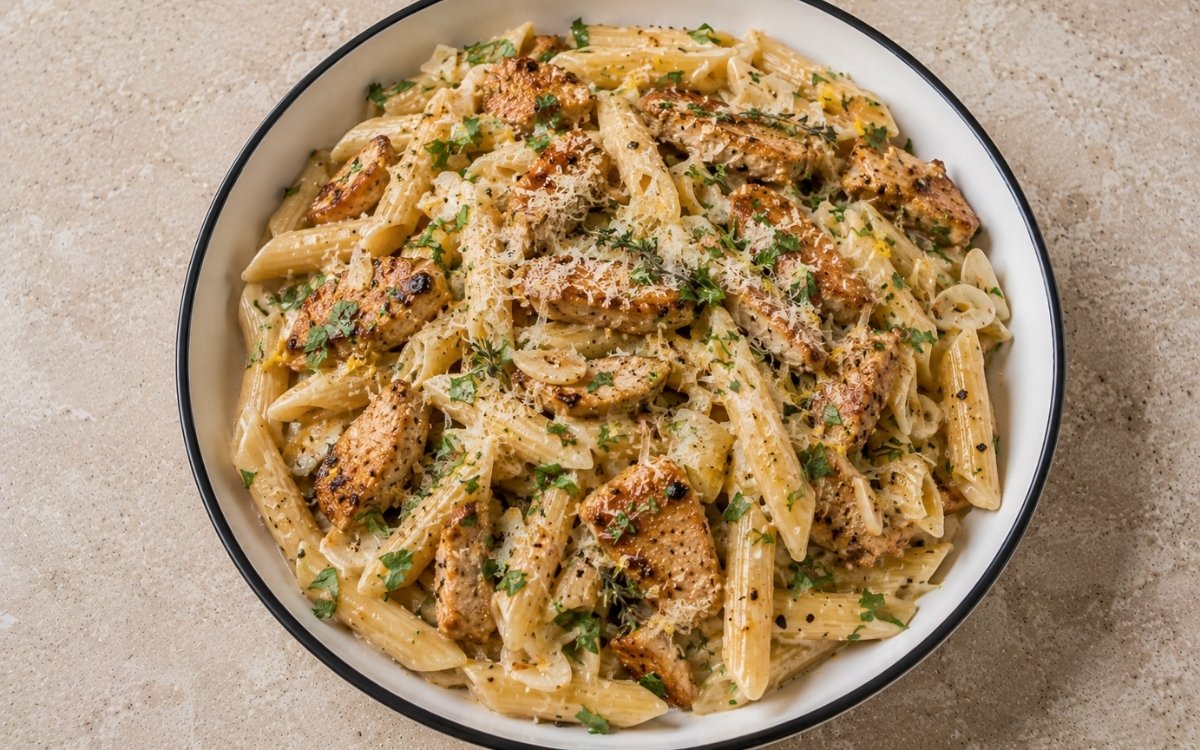
Ingredients
Method
Cook the Pasta
- Bring a large pot of water to a full rolling boil and add the 4g of kosher salt. Add the penne or rigatoni and cook until exactly 2 minutes shy of the package's al dente time — the pasta finishes cooking in the cream sauce during the final tossing step. Before draining, reserve 180ml of the starchy pasta water in a heatproof jug and keep it warm. Drain without rinsing and set aside.
Sear the Chicken Thighs
- Pat the 500g of chicken thigh pieces completely dry on all surfaces with paper towels — any surface moisture converts to steam on contact with the hot pan, preventing the caramelised, golden crust that contributes both flavour and visual appeal. Season generously with the 2g of salt and 2g of black pepper. Heat the 15ml of olive oil and 15g of butter together in a large, deep skillet over medium-high heat. The butter-olive oil combination provides the sweet dairy richness of the butter while the olive oil raises the overall fat's smoke point above pure butter's threshold, preventing burning during the high-heat sear. Wait until the butter has melted completely and its foam subsides — the subsiding foam indicates the water content has evaporated and the fat is at the correct temperature for searing. Add the chicken pieces in a single layer, working in batches if the pan cannot accommodate all 500g without crowding. Leave completely undisturbed for 3–4 minutes — the Maillard reaction requires sustained, uninterrupted contact between the chicken surface and the hot pan to develop the deep golden-brown crust. Flip each piece and cook for a further 3–4 minutes until just cooked through to 74°C internal temperature and golden on the second side. Transfer to a plate with all accumulated juices — these juices return to the pan at the combining step and add chicken-forward depth to the cream sauce.
Build the Garlic Base
- Reduce the heat to medium. Add the remaining 30g of butter to the same skillet without cleaning it — the fond from the chicken sear and the residual fat are the cooking medium for the garlic and the foundation of the sauce's depth. Once the butter has melted, add the 40g of thinly sliced garlic and 2g of red pepper flakes simultaneously. Cook, stirring constantly, for 90 seconds. Eight cloves is a generous garlic quantity deliberately calibrated for a dish that calls itself garlic Parmesan pasta — at this amount the garlic is the dominant flavour of the cream sauce rather than a background note. The thinly sliced format — rather than minced or grated — produces pieces that cook evenly throughout and provide occasional distinct garlic pieces within the sauce alongside the overall garlic infusion of the cream. Constant stirring at medium heat is essential — thin garlic slices in hot butter move from pale golden and fragrant to browned and bitter in under 30 seconds of stationary contact. Add the 8g of fresh thyme leaves and cook for 15 seconds — the thyme blooms its aromatic compounds into the surrounding garlic butter almost instantly at this temperature.
Build and Reduce the Cream Sauce
- Pour in the 300ml of heavy cream and 180ml of whole milk in a steady stream. Bring to a gentle simmer, stirring simultaneously and scraping the bottom of the pan firmly with a wooden spoon — the fond from the chicken sear dissolves into the cream as it heats, distributing concentrated chicken flavour through the entire sauce. The combination of cream and milk rather than cream alone produces the correct balance of richness and flowability for this sauce — heavy cream alone at this quantity would produce a very thick, very heavy sauce that coats the pasta oppressively; the milk lightens the dairy fat content and produces a sauce that is rich and coating while still flowing freely between each piece of pasta. Simmer for 4–5 minutes, stirring occasionally, until the sauce has reduced by approximately one-quarter and coats the back of a spoon with a clear, defined line when you run your finger through it. Remove from heat. Add the 120g of finely grated Parmigiano-Reggiano in three separate additions — scatter one-third, whisk vigorously until completely melted, add the second third, whisk again, add the final third, and whisk until the sauce is smooth, glossy, and uniformly cream-coloured. The three-addition, off-heat technique prevents the protein-seizing and fat-separation that occurs when Parmigiano is added all at once to a boiling sauce. The sauce should be visibly glossy and slightly thickened at this point.
Finish the Pasta in the Sauce
- Return the seared chicken pieces and every drop of their accumulated resting juices to the skillet. Add the drained, underdone pasta directly to the sauce along with 60ml of the reserved pasta water. Return to medium heat. Toss continuously for 2–3 minutes — lifting the pasta and chicken through the cream sauce, ensuring every piece is coated and the pasta's surface starch releases into the sauce, progressively thickening and enriching it. The pasta absorbs the garlic-cream character throughout its structure during these final 2–3 minutes of in-sauce cooking rather than simply being coated externally. Add reserved pasta water in additional 30ml increments if the sauce tightens beyond the correct flowing, coating consistency — the finished sauce should cling luxuriously to each piece of pasta rather than pooling at the bottom of the pan.
Finish and Serve
- Remove from heat. Add the lemon zest, half of the 15g of finely chopped parsley, and the remaining 1g of black pepper. Stir gently to distribute. Taste and adjust with additional salt if needed — the Parmigiano and chicken sear both contribute significant salt, and the sauce may need very little or no additional seasoning. Divide among four warm bowls immediately — cream sauces continue thickening as they cool and the dish is at its best in the first few minutes after leaving the pan. Scatter the remaining parsley over each bowl. Add additional finely grated Parmigiano at serving. Serve immediately.
Notes
Eight garlic cloves for four servings is a quantity that surprises people accustomed to recipes where garlic is used as background flavouring rather than a feature ingredient. In this dish it is explicitly a feature — the sauce identifies itself as garlic Parmesan, and the garlic must be present enough to merit that description in every bite. The thinly sliced format rather than minced is what makes this possible: thinly sliced garlic cooked carefully to pale golden in butter produces a sweet, toasted, mellow flavour rather than the sharp pungency of raw garlic. At golden rather than browned, the garlic has undergone the Maillard reaction at its sugars' level without producing the bitter compounds that browning introduces. The result is a sauce where garlic is a clear, pleasant, sweet-savoury presence rather than an aggressive one.
The three-addition Parmigiano technique is the universal method for incorporating hard aged cheeses into hot cream sauces without clumping or graininess. When Parmigiano is added to a boiling or near-boiling cream sauce, the outer surface of each portion of cheese heats immediately and its proteins seize — forming a protective layer that prevents the interior from melting smoothly. Added in thirds off the heat, with vigorous whisking between each addition, the cheese is fully distributed and melted before the next quantity is introduced. The result is a sauce that is uniformly smooth and glossy rather than spotted with unmelted cheese clusters.