Ingredients
Method
Cook the Fish
- Place the fish in a small pan with enough water to barely cover it. Add the salt, black pepper, and lime juice. Bring just to a gentle simmer over medium-low heat and cook for about 5 to 8 minutes, depending on thickness, until the fish is just cooked through and flakes easily. Lift the fish out to a plate and reserve some of the cooking liquid. Flake the fish into small pieces with a fork. Do not aggressively boil the fish. Gentle cooking keeps it moist so the filling stays tender instead of dry. That gentle simmer protects the fish's own delicate texture from the toughening a hard boil would cause, while the reserved cooking liquid becomes a genuine, flavourful tool used repeatedly throughout the rest of the recipe.
Make the Fish Filling
- Heat the oil in a skillet over medium heat. Add the onion and cook for 4 to 5 minutes until softened. Add the garlic, cumin, and achiote or paprika and cook for 30 seconds more. Add the flaked fish and stir gently to combine. If the mixture seems too dry, add 30 to 60ml of the reserved cooking liquid. Cook for 1 to 2 minutes just to bring everything together, then stir in the cilantro. Transfer to a plate or bowl and let it cool. The filling should be moist and flavorful, but not wet or loose. If it looks watery, cook it a little longer so excess moisture evaporates. That specific, checkable texture — moist but genuinely not wet — is what protects the plantain dough's own ability to seal completely around the filling once assembly begins.
Peel and Grate the Plantains
- Cut off the ends of the green plantains and score the peel lengthwise. Remove the peel completely. Grate the peeled plantains on the large holes of a box grater. Green plantains stain and release sticky sap, so lightly oiling your hands or knife can make peeling easier. That light coating of oil creates a genuine barrier between your hands and the plantain's own sap, which is considerably harder to remove once it's had a chance to dry and stain directly on bare skin.
Cook the Plantain Dough
- In a wide pan, heat the oil over medium heat. Add the onion and cook for 4 to 5 minutes until softened. Add the garlic and cook for 30 seconds. Add the grated plantain, ground peanuts, cumin, and salt. Stir well, then begin adding the reserved fish liquid or water a little at a time, starting with 240ml. Cook over medium to medium-low heat for 8 to 12 minutes, stirring often, until the plantain mixture thickens into a heavy dough-like masa. If it seems too dry and stiff before the plantain fully cooks, add a little more liquid. If it seems loose, keep cooking and stirring until it firms up. The masa is ready when it looks thick, matte rather than raw and shiny, and pulls together enough to hold its shape when pressed with a spoon. That shift from shiny to matte is a genuine, reliable visual cue confirming the plantain's own starches have properly cooked and thickened — a masa still shiny and loose hasn't yet reached the structural point this dough needs to actually hold its shape once formed.
Cool the Dough
- Transfer the plantain mixture to a tray or bowl and let it cool until warm but comfortable to handle. Do not try to shape the corviche while the masa is hot. Warm dough seals better and is much easier to handle. That cooling period lets the plantain's own starches firm up further as they cool, giving the dough real structural integrity it simply doesn't have while still piping hot and loose.
Fill and Shape the Corviche
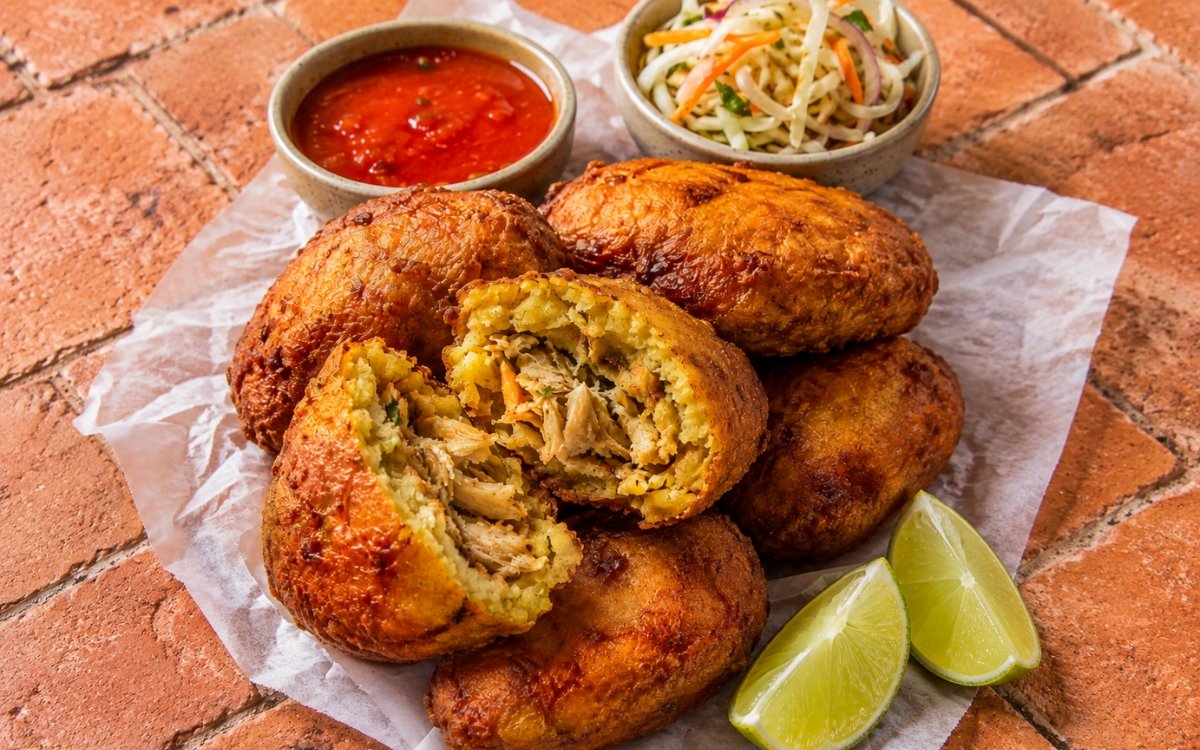
- Divide the plantain dough into 12 equal portions. Keep a small bowl of water nearby for your hands. Take one portion and flatten it into a thick oval in your palm. Place a spoonful of fish filling in the center. Fold the dough around the filling and seal it completely, then shape it into an oval torpedo or football shape. Repeat with the remaining dough and filling. Make sure no filling is exposed and patch any thin spots with a little extra dough. If the corviche split, they can open in the oil. That thorough, deliberate sealing — checking specifically for exposed filling or thin spots — is what protects each dumpling from splitting open once it hits the genuinely hot oil, where any weak point would be exposed immediately.
Fry the Corviche
- Heat frying oil to 175°C. Fry the corviche in batches, without crowding, for about 4 to 6 minutes, turning as needed, until deeply golden brown and crisp outside. Transfer to a rack or paper towel-lined tray. If the oil is too cool, the corviche absorb oil and turn heavy. If it is too hot, they brown before the center is heated through. Maintaining that specific oil temperature protects the corviche from both directions at once — too cool lets the dough soak up excess fat before it ever crisps, while too hot darkens the outside long before the filling inside has genuinely warmed through.
Serve
- Serve hot with lime wedges and a small dish of red salsa, ají, or curtido on the side. Serving while the corviche are still genuinely hot delivers them at their crispest — that exterior texture softens steadily the moment they come off the heat.
Notes
Cooking the plantain mixture until it reaches that specific, checkable thick and matte point deserves genuine respect as the technique most responsible for whether the finished dough can actually be shaped and sealed properly. That visual and textural cue — matte rather than shiny, holding its own shape when pressed — confirms the plantain's own starches have genuinely gelatinized and thickened, giving the dough real structural integrity rather than relying on a fixed cooking time alone to guess at doneness.
Keeping the fish filling moist but deliberately not wet deserves the same attention this collection gives to every dumpling filling that needs to seal cleanly inside a dough wrapper. Excess liquid in the filling works directly against the surrounding dough's own ability to seal completely — the recipe's own explicit guidance to cook off any watery texture reflects a genuine, functional requirement rather than a minor preference.
Letting the cooked plantain dough cool to warm before ever attempting to shape it deserves recognition as a real, necessary step rather than simple patience. Hot masa lacks the structural firmness a properly cooled dough develops, and attempting to shape and seal it while still piping hot would produce a considerably weaker, more failure-prone result once it meets the hot frying oil.
Maintaining the specific 175°C frying temperature deserves genuine attention given how directly it affects the finished corviche in two opposite directions. Oil that's too cool lets the dough absorb excess fat before it has any chance to crisp, while oil that's too hot browns the exterior well before the filling inside has actually warmed through — that narrow target temperature is what avoids both failure modes simultaneously.