Ingredients
Method
Cook the Eggs
- Bring a saucepan of water to a boil. Lower in the eggs carefully and boil for 9–10 minutes for fully set yolks. Transfer immediately to ice water or very cold water and cool completely. Peel and halve. The yolks should be fully set but still bright yellow, not chalky and grey-rimmed. That immediate ice bath does genuine, active work beyond simple cooling — it halts the carryover cooking that would otherwise push the yolk toward that dulled, grey-rimmed overcooked appearance.
Cook the Bacon
- Lay the bacon in a cold skillet and place over medium heat, or bake on a tray at 200°C until crisp. Cook until deeply browned and rendered but not burnt. Drain on paper towels, then cut or crumble into bite-size pieces. The bacon should be crisp enough to stay distinct in the salad, not soft and fatty. That genuine crispness is what keeps the bacon reading as its own distinct component within the composed rows, rather than disappearing into the surrounding lettuce and toppings.
Cook the Chicken
- If the chicken breasts are thick, butterfly them horizontally or slice them into thinner cutlets. Lightly pound the thickest parts if needed so they cook evenly. Season with olive oil, salt, black pepper, and garlic powder. Sear in a hot skillet or grill pan over medium-high heat for about 3–5 minutes per side, depending on thickness, until lightly charred and the internal temperature reaches 74°C. Transfer to a board and rest for 5–10 minutes, then cut into small bite-size cubes. Cook the chicken whole first, then cube it after resting. This keeps it juicier than cutting before cooking. Resting whole before cubing lets the meat's own internal juices, pushed toward the centre under cooking's heat, redistribute evenly back through the breast — cutting into smaller pieces immediately would release much of that moisture right onto the board instead.
Make the Vinaigrette
- In a bowl or jar, combine the red wine vinegar, Dijon, garlic, salt, and black pepper. Whisk well. Slowly drizzle in the olive oil while whisking until emulsified. Taste and adjust if needed. The vinaigrette should be sharp, savoury, and balanced enough to dress a rich salad with bacon, egg, avocado, and blue cheese. That deliberate sharpness is a genuine, functional requirement given how rich this particular salad's toppings are — a milder vinaigrette would be overwhelmed rather than providing the real, cutting contrast this composed plate depends on.
Prepare the Lettuce
- Wash and dry the romaine and iceberg very thoroughly. Chop into bite-size pieces and place in a large wide serving bowl or platter. The lettuce must be very dry or the vinaigrette will slide off and the salad will lose definition. Any residual surface water on the leaves dilutes the vinaigrette on contact and prevents it from actually adhering — that thorough drying is what gives the dressing something real to cling to instead of pooling uselessly at the bottom of the bowl.
Assemble the Cobb Salad
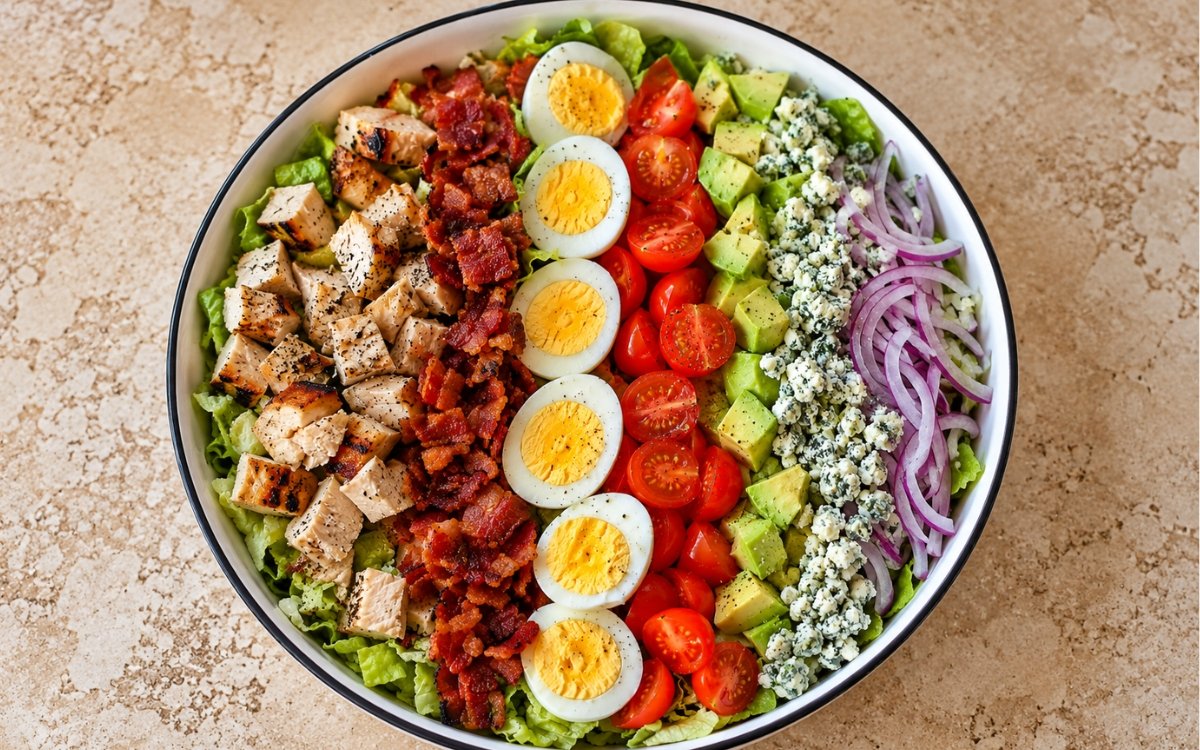
- Lightly season the lettuce with a small pinch of salt and a little black pepper. You can toss it with a small amount of vinaigrette or leave the dressing for serving, depending on how composed you want the salad to stay. For the most classical composed look, keep the top ingredients arranged in rows and serve the remaining vinaigrette on the side or drizzle lightly just before serving. Arrange the toppings in neat rows over the lettuce: cubed chicken, crispy bacon, halved hard-boiled eggs, halved cherry tomatoes, diced avocado, blue cheese crumbles, and thinly sliced red onion. Drizzle lightly with vinaigrette or serve it alongside. Arranging every topping in distinct, visible rows rather than tossing everything together is what gives a proper Cobb salad its whole classical identity — each component stays recognisable on its own rather than blending into an undifferentiated mix.
Notes
Cooking the chicken whole and resting it before cubing deserves genuine respect as the technique responsible for whether the finished meat stays juicy or dries out. Cutting into smaller pieces before or immediately after cooking exposes far more surface area to both the direct heat and the subsequent moisture loss — cooking and resting whole, then cubing only once the juices have had time to redistribute, protects that moisture right through to the finished salad.
Drying the lettuce very thoroughly deserves the same attention this technique receives throughout this collection's other dressed and composed salads. A Cobb salad's whole visual and textural appeal depends on distinct, well-defined components, and a wet leaf that repels the vinaigrette rather than holding it would undermine that definition considerably faster than a properly dried one.
The recipe's own explicit instruction to add the avocado last, right before serving, deserves genuine attention as a real, practical safeguard rather than a minor detail. Avocado begins browning from oxidation almost immediately once cut, and delaying its addition until the very final assembly step protects that fresh, vivid green appearance for as long as possible before the plate reaches the table.
Building the vinaigrette specifically sharp and savoury, rather than mild, deserves recognition as a genuine, functional requirement given this particular salad's composition. Bacon, egg, avocado, and blue cheese together bring real, substantial richness to the plate, and a vinaigrette calibrated to actually cut through that richness is what keeps the whole salad tasting balanced rather than heavy.