Ingredients
Method
Make the Hoagie Dough
- Add the warm milk, yeast, and sugar to a mixing bowl. Stir and let stand for 5–8 minutes, until lightly foamy. Add the flour, salt, eggs, and softened butter. Mix until a soft dough forms, then knead for 8–10 minutes by hand or 5–7 minutes in a stand mixer, until smooth and elastic. Cover and let rise for 1–1½ hours, until roughly doubled. The dough should feel soft and slightly enriched, not dry and stiff. A dry roll will make the sandwich feel heavy and bready instead of tender-crisp. Kneading to a genuinely smooth, elastic consistency develops the gluten structure needed for a roll with an open, tender crumb — a dough that's under-kneaded or too dry produces a denser bake regardless of how long it's proofed afterward.
Shape and Bake the Hoagie Rolls
- Divide the dough into 4 equal pieces. Shape each into a long hoagie roll, about 18–20cm long. Place on a lined baking tray, cover loosely, and proof for 35–45 minutes, until puffy. Bake at 190°C for 18–22 minutes, until deeply golden. Cool before splitting. The rolls should be golden outside and soft inside. They need enough structure to hold sauce and chicken, but they should not be hard like a dry baguette. Cooling before splitting matters directly here — bread continues setting internally for a period after leaving the oven, and cutting into it too early compresses that still-soft crumb into something denser and gummier than the same roll would be once fully cooled.
Make the Marinara
- Heat the olive oil in a saucepan over medium heat. Add the sliced garlic and cook for 60–90 seconds, stirring constantly, until fragrant and just beginning to turn golden at the edges. Add the crushed tomatoes, salt, sugar, oregano, and black pepper. Simmer uncovered for 20–25 minutes, stirring occasionally, until slightly thickened. Add the basil in the final minute, then remove from the heat. The marinara should be thicker than a pasta sauce. It needs enough body to sit on the cutlet without flooding the bread. Simmering uncovered, rather than covered, allows steam and excess moisture to escape freely as the sauce cooks — that open reduction is exactly what concentrates the marinara into something thick enough to sit on the cutlet's surface rather than pooling and running off it.
Prepare the Chicken Cutlets
- Butterfly the chicken breasts and pound them to just under 1cm thick. Set up 3 bowls: flour seasoned with salt and black pepper, beaten eggs, and breadcrumbs mixed with Parmesan and dried oregano. Coat each cutlet in flour, then egg, then the Parmesan breadcrumb mixture. Press the crumbs on firmly so the coating adheres. The chicken must be thin and even. If the cutlets are too thick, the crust browns before the center cooks properly. Pounding to a consistent thickness across the whole cutlet matters directly for the fry that follows — an unevenly thick piece forces a compromise where the thin section overcooks before the thick section has finished, especially over the fairly brief frying time this cut needs.
Fry the Cutlets
- Heat vegetable oil to 175°C. Fry the cutlets in batches for about 3 minutes per side, until deep golden brown and cooked to 74°C internally. Transfer to a wire rack, not paper towels. The crust should be golden, crisp, and dry-looking. A wire rack keeps steam from softening the underside. Any hot, freshly fried item resting on a flat surface or absorbent paper traps steam beneath it — that trapped moisture softens the crisp coating from below within minutes, which is exactly what a wire rack's open structure avoids.
Melt the Sauce and Cheese
- Preheat the oven to 200°C. Place the fried cutlets on a tray. Spoon marinara over the center of each cutlet, leaving some crust exposed at the edges. Top with mozzarella and grated Parmesan. Bake for 8–10 minutes, until the cheese melts and the sauce bubbles. Broil for 60–90 seconds if needed for browned, bubbling cheese. Do not bury the entire cutlet in sauce. The exposed crust edges are what keep the sandwich from becoming soft all the way through. Deliberately leaving a visible border of crust uncovered by sauce and cheese means that edge stays dry and crisp throughout baking — a fully sauced, edge-to-edge cutlet would lose that structural contrast entirely, going soft across its whole surface rather than only at the centre.
Toast the Rolls
- Split the hoagie rolls lengthwise without cutting all the way through. Toast the cut sides lightly in the oven or under the broiler until warm and slightly crisp. Brush with a little olive oil if desired. The roll needs light toasting before assembly. Untoasted bread absorbs marinara too quickly and loses structure. This toast gives the roll real, if modest, resistance against the sauce and melted cheese fat about to be piled inside — an untoasted roll would have considerably less tolerance for that moisture before it starts breaking down.
Assemble the Chicken Parm Heroes
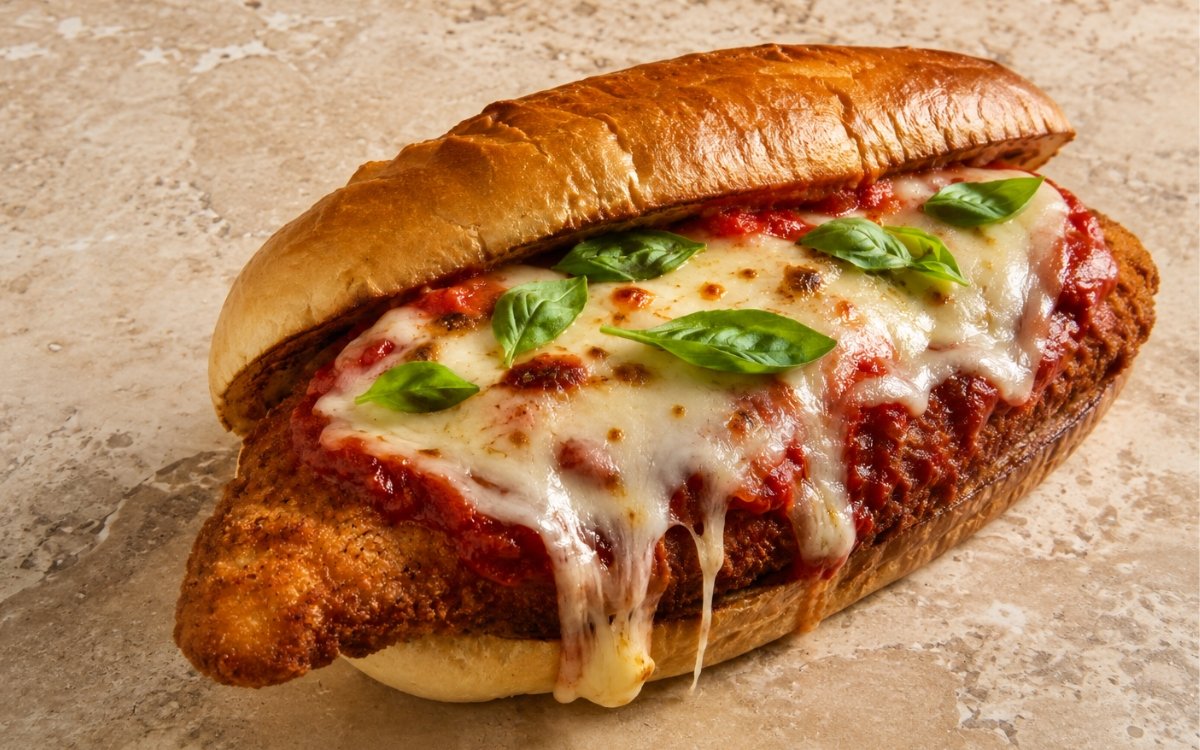
- Place one hot chicken parm cutlet into each toasted roll. Let the cutlet extend beyond the bun if it is large. Spoon over a little extra warm marinara if needed, then add fresh basil leaves. Serve immediately. The final sandwich should be hot, crisp-edged, saucy in the center, and cheesy. The mozzarella should pull slightly at the edges, but the bread should still hold cleanly when picked up. Assembling as the very last step, once every other component is already fully finished and hot, is what delivers the sandwich at its peak — any delay between the cheese melting and the sandwich being eaten works directly against the crisp-edge structure the rest of the recipe was built to protect.
Notes
Keeping the marinara genuinely thick, well past the consistency of a standard pasta sauce, is worth understanding as a defensive measure protecting the sandwich's entire structure, not just a flavour preference. A thinner sauce, however good it tastes, simply carries too much liquid to sit stably on a fried cutlet without running off the edges and directly into the bread — thickness here is functional as much as it is a matter of taste.
Leaving crust exposed at the cutlet's edges when saucing and cheesing addresses the same underlying vulnerability from a different angle. Rather than trying to make the entire sandwich uniformly saucy and cheesy, this technique deliberately preserves one dry, crisp zone that survives the baking stage intact — that contrast between a soft, saucy centre and a crisp outer edge is a genuine structural feature of a properly built chicken parm hero, not an accident of imprecise saucing.
Pounding the chicken cutlets to a genuinely even thickness matters more than it might seem for a component that's also being fried, breaded, and then baked again with sauce and cheese on top. An unevenly thick cutlet risks overcooking in its thinner sections during the initial fry alone — problems compounded further once that same cutlet goes through a second round of oven heat during the cheese-melting stage.
Toasting the hoagie roll before assembly, and assembling only as the very final step once everything else is hot and ready, both protect the same vulnerable structure from two different directions. The toast gives the bread genuine resistance against moisture it's about to receive; the immediate assembly-and-serve timing is what keeps that moisture exposure as brief as possible before the sandwich reaches the table.