Ingredients
Method
Prepare the Noodles
- Prepare the 350g dry flat rice noodles according to the package, usually a soak in hot water or a brief blanch, but stop as soon as they are just pliable and slightly underdone, typically 1–2 minutes short of the package time. They should bend easily around a finger yet still feel a little firm at the centre when bitten. Drain well, rinse briefly under cool water only if they keep softening, then toss with about 1 tsp of the extra neutral oil so the strands do not clump. You need 800g cooked noodles in total. If a strand already tastes fully tender, drain the rest immediately and rinse them cool. That deliberate underdoneness is what leaves the noodles room to finish in the wok, where they absorb the sauce and soften the rest of the way without turning sticky.
Mix the Sauce
- In a bowl, combine the 6 tbsp tamarind, 5 tbsp fish sauce, 70g palm sugar and 2 tbsp of the water, and stir until the sugar has mostly dissolved, pressing any harder lumps of palm sugar against the side of the bowl. Taste the sauce: it should be clearly tangy from the tamarind, salty from the fish sauce and noticeably sweet, but never dessert-sweet. If it tastes too sharp, stir in a little extra sugar; if it tastes too thick or intense, add the remaining 1 tbsp water. Tamarind products vary widely in strength, so if your concentrate is very strong, add it gradually and taste as you go. That slightly over-strong balance is what keeps the finished pad thai bright, since the noodles, egg, chicken and sprouts all dilute the sauce once it coats them.
Set Up the Stir-Fry
- Season the 800g sliced chicken evenly with the ½ tsp fine salt and ¼ tsp black pepper, tossing so every strip is lightly coated. Crack the 4 eggs into a bowl and beat lightly, just until the yolks and whites are combined. Arrange the chopped garlic, sliced shallots, 180–200g bean sprouts and cut garlic chives in separate small piles, and mentally split each one, along with the noodles, sauce and eggs, into 2 equal portions — one for each batch. Set everything beside the stove with the serving garnishes, a warm tray or bowl for the first batch and a little water for loosening the noodles. Once the wok is hot, the cooking moves far too quickly to stop and chop. That complete mise en place is what lets each batch finish in about 3 minutes, before the noodles have time to stew.
Cook the Chicken
- Heat a large wok or wide heavy skillet over medium-high to high heat until it is very hot and a drop of water skitters across the surface. Add 1½ tbsp of the neutral oil and swirl to coat. Add the chicken in a single layer — in 2 quick batches if the pan cannot hold it without the strips overlapping — and cook for 3–5 minutes per batch, stirring only occasionally, until just cooked through to 74°C in the thickest strip and lightly browned in spots. Remove to a plate. If the pan floods with liquid and the chicken turns grey, it is crowded, so lift some out and let the heat recover. That browning, rather than steaming, is what gives the chicken a savoury, lightly caramelised surface while the inside stays juicy.
Stir-Fry the First Batch
- Return the wok to high heat and add ¾ tbsp of the neutral oil, plus a little more if the surface looks dry. Add half the garlic and half the shallots and stir-fry for 20–30 seconds, until fragrant but not browned. Add half the noodles and toss briefly, then pour in half the sauce and toss for about 1 minute, until the noodles start to absorb it and turn glossy. Push the noodles to one side, pour 2 of the beaten eggs into the open space and scramble lightly until softly set. Add half the chicken, half the bean sprouts and half the garlic chives, and toss everything together for 30–60 seconds, just until hot, glossy and evenly mixed. If the noodles clump, loosen them with tongs and a tiny splash of water. That high, steady heat is what lets the noodles fry rather than stew, keeping each strand distinct.
Stir-Fry the Second Batch
- Transfer the first batch to the warm tray or bowl and cover it only loosely, so it stays warm without trapping steam that would soften the noodles. Scrape out any scorched bits of garlic, return the wok to high heat and add the remaining ¾ tbsp neutral oil. Repeat the same sequence with the remaining garlic, shallots, noodles, sauce, 2 eggs, chicken, bean sprouts and garlic chives, keeping every step just as quick. The bean sprouts and chives should finish crisp and vivid green, barely wilted at the edges; if they slump, the batch has stayed in the pan too long. That second, separate batch is what keeps the wok hot enough to give both halves the same glossy, springy texture.
Finish and Serve
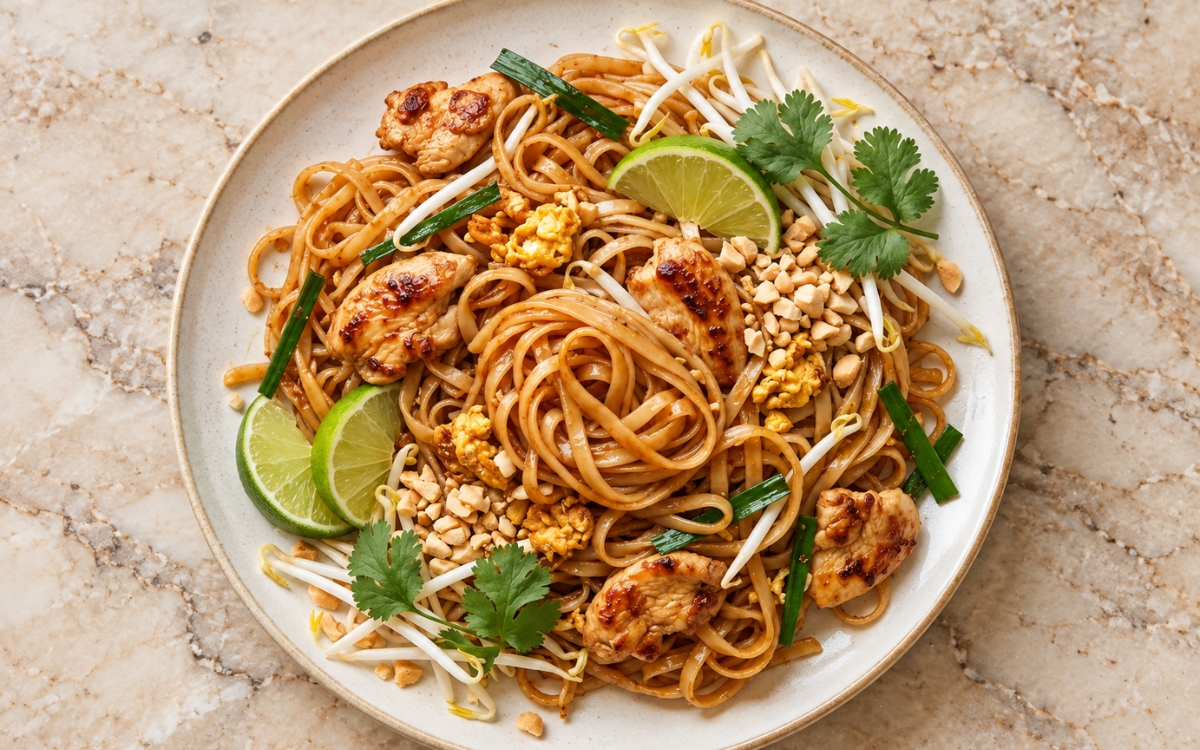
- Divide both batches of pad thai evenly between 4 bowls, lifting the noodles with tongs so the chicken, egg and sprouts are spread through each portion. Top each bowl with a share of the 60–80g chopped peanuts, a small pile of extra bean sprouts, a lime wedge, a few cilantro leaves and the extra garlic chive pieces, if using. The noodles should look glossy and tender but still distinct and springy, never mushy or pooled in sauce. If a bowl tastes flat, add a few drops of extra fish sauce or a squeeze more lime; if it tastes too sour, a pinch of extra sugar rounds it out. Serve immediately, with extra lime wedges at the table. That last-minute garnish is what gives each bowl its crunch, freshness and sharp citrus lift.
Notes
Stopping the noodles while they are still slightly underdone deserves genuine recognition as the technique most directly responsible for whether this pad thai turns out springy or gummy. Rice noodles keep absorbing liquid and softening as they toss in the hot wok — the recipe's own cue that they should end up "glossy and tender, but still distinct and springy, never mushy" is only reachable if they enter the pan with some resistance left.
Cooking in 2 batches deserves the same attention this technique receives throughout this collection's other wok-fried noodle dishes, because a home burner cannot hold its heat under a full 4-serving load. The recipe's own instruction to "Keep the heat fairly high so the noodles fry rather than stew" depends on that split — a half load lets moisture flash off, while a full one drops the temperature and leaves the noodles steaming in sauce.
The deliberately strong sauce deserves genuine respect as the detail most directly responsible for a pad thai that tastes bright rather than flat. The recipe's own note that "Pad thai sauce should taste slightly stronger than you think is necessary on its own" reflects simple dilution — 800g of noodles, plus the egg, chicken and sprouts, mute the tamarind, fish sauce and sugar once the sauce coats everything.
The texture of the bean sprouts and garlic chives deserves attention as a genuine, checkable readiness cue rather than a loose approximation. They go in last and stay in the pan for only 30–60 seconds, so if they look limp and dull instead of crisp and vivid, the batch has cooked too long — and the noodles have almost certainly softened past their best as well.