Ingredients
Method
Season and Prepare the Chicken
- Slice each chicken breast lengthwise into 3 even strips of approximately 1.5cm thickness — cutting along the length of the breast rather than across it to produce long, substantial strips that sear well and slice cleanly after resting. Cutting into even 1.5cm thickness ensures all strips reach 74°C at the same time during searing. In a bowl, combine the olive oil, garlic powder, onion powder, salt, and several good cracks of black pepper. Add the chicken strips and turn to coat every surface thoroughly. The seasoning here is deliberately clean and restrained — garlic powder, onion powder, salt, and pepper only. This is not the place for smoked paprika, cumin, or any deep spice that would introduce competing flavour notes into the Alfredo sauce, which relies on the purity of butter and Parmigiano as its entire flavour identity. The chicken's role is to provide juicy, well-seasoned protein above the pasta — it should complement the sauce rather than fight it. The most important seasoning decision is the salt level: season generously enough that the chicken tastes well-seasoned on its own, because it will not absorb any additional seasoning after cooking.
Boil the Pasta Water
- Fill a large pot with water and add the 30–40g of fine sea salt — the water should taste noticeably salty, similar to well-seasoned broth. The quantity seems large but it seasons the fettuccine throughout during cooking in a way that no amount of sauce-level seasoning can replicate. Bring to a full rolling boil. Hold at the boil until the chicken is seared and resting — you will add the pasta at that point so both components finish at approximately the same time.
Sear the Chicken Strips
- Heat a large cast iron, stainless steel, or carbon steel pan over medium-high heat until genuinely hot — a drop of water should evaporate immediately on contact. Add the olive oil and allow it to spread across the entire pan surface. Add the seasoned chicken strips in a single layer without crowding — work in two batches if the pan cannot accommodate all strips with space between them. Lay them away from you to prevent oil splashing. Leave undisturbed for 3–4 minutes until the bottom surface shows a deep golden sear and the strip releases naturally from the pan. Flip and sear the second side for 2–3 minutes. The internal temperature should reach 74°C at the thickest point. The chicken strips at 1.5cm thickness cook relatively quickly — monitor the temperature rather than relying solely on timing. Transfer all seared strips to a cutting board and allow to rest — the resting is important both for juice redistribution and because the cutting-board juices that accumulate during the rest will be added to the pasta at the end.
Cook the Fettuccine to Al Dente
- While the chicken sears, drop the fettuccine into the aggressively salted boiling water. Cook for 1–2 minutes less than the package instructions indicate — the pasta will finish cooking in the sauce pan and needs to be slightly underdone when it leaves the boiling water. Before draining, reserve at least 150ml of the starchy pasta water in a jug — this pasta water is not an afterthought but an active ingredient in the emulsification. Its starch content is the emulsifying agent that allows the butter and Parmigiano to form a stable, creamy sauce rather than breaking into separated grease and cheese. Drain the fettuccine and set aside briefly — do not rinse, which washes away the surface starch that also contributes to sauce adhesion.
Build the Alfredo in the Chicken Pan
- Without cleaning the pan, pour the drained fettuccine directly onto it over low heat. The fond — the caramelised chicken and olive oil residue on the pan surface — is concentrated savory flavour that will be lifted by the pasta water and absorbed into the sauce. Deglaze with a splash of the reserved pasta water, using a spatula or tongs to scrape the fond from the surface as the water bubbles — every bit of this fond contributes a depth that no amount of seasoning can substitute. Add the cubed butter and begin tossing the pasta continuously — lift from the bottom, fold over the top, repeat in a continuous motion. As the butter melts into the starchy pasta and fond-infused water, the sauce begins to emulsify: the fat and water combine into a creamy, cohesive coating rather than separating as they would without the starch. Add the pasta water gradually — pour in 30–40ml at a time while tossing rather than all at once, which would produce a watery, broken sauce. Add the lemon zest and continue tossing. The lemon zest is the single aromatic addition that makes genuine Alfredo feel complete — present as a warm, citrus background note that lifts the butter's richness rather than adding flavour the sauce lacks.
Add the Parmigiano Gradually
- This is the most technically important step in the recipe. Add the finely grated Parmigiano Reggiano in three or four additions rather than all at once, tossing vigorously between each addition. The gradual addition allows each portion to melt and incorporate into the emulsifying sauce before the next is added — too much cheese at once drops the sauce temperature, seizes the proteins, and produces a grainy, clumped result rather than a smooth, coating sauce. Keep the heat at its absolute lowest during the cheese addition — or switch it off entirely and use the residual pan heat only. Between each Parmigiano addition, add a small amount of additional pasta water if the sauce begins to tighten or look dry rather than glossy and fluid. The final sauce should coat the pasta with a creamy, slightly glossy sheen — it should flow slowly when the pan is tilted rather than sitting as a stiff paste or running like thin liquid. When the last addition of Parmigiano has been incorporated and the sauce looks smooth and coating, turn the heat off completely. Continue tossing for 30–60 additional seconds off the heat — the residual warmth continues the emulsification without risking overheating the cheese.
Slice the Chicken and Serve
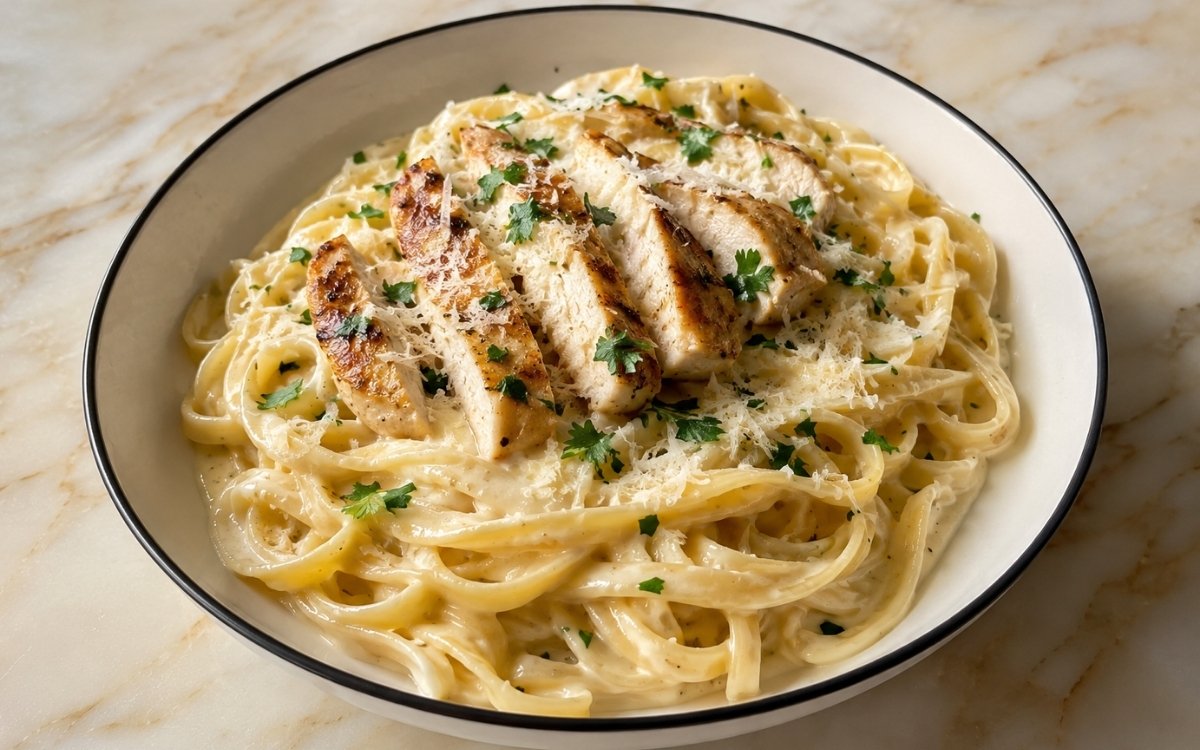
- Slice the rested chicken strips across their width into approximately 1cm thick pieces. As you slice, the cutting board will have accumulated a pool of resting juices — pour these directly into the pasta and toss briefly. These juices are flavoured with the garlic and onion seasoning from the chicken, carry the fat rendered during searing, and add both flavour and a small amount of additional liquid that further loosens the sauce to the perfect serving consistency. Divide the fettuccine Alfredo among four wide, warm bowls — twirl the pasta into a nest in the centre of each bowl using tongs for the cleanest presentation. Lay the sliced chicken pieces over the top of each pasta portion. Scatter additional finely grated Parmigiano over each bowl. Finish with the finely chopped fresh parsley scattered across the surface — its clean, slightly grassy freshness provides both the herbal aroma and the green colour contrast that makes the dish visually complete against the pale, golden pasta and white cheese.
Notes
The absence of cream in this recipe is not an omission — it is the correct preparation. The original Alfredo di Lelio, invented in Rome in the early 20th century, contained only pasta, butter, and Parmigiano. Cream was added in American adaptations to produce a sauce that was more stable, less technique-dependent, and more forgiving of the lower-quality Parmigiano available outside Italy. Cream-based Alfredo is a different, heavier sauce with a less pure, less cheese-forward flavour. The butter-and-Parmigiano emulsion of authentic Alfredo, when executed correctly, is cleaner, more intense, and more interesting than any cream version — but it requires the correct technique and the correct pasta water starch to achieve the stable emulsification.
Parmigiano Reggiano quality is more critical in this recipe than in any other in this collection because there are no other strong flavours present to compensate for inferior cheese. A genuine Parmigiano Reggiano — the DOP-certified hard cheese aged a minimum of 12 months from the Emilia-Romagna region — has a specific granular texture, a savoury-sweet depth, and a precise saltiness that pre-grated or generic Parmesan cannot replicate. For a sauce where the cheese is literally the entire flavour story alongside butter, this difference is immediately and dramatically apparent in the finished dish. Buy a wedge and grate it yourself immediately before use — pre-grated Parmigiano loses its volatile aromatic compounds within hours of grating and produces a flat, dull Alfredo.
The chicken seasoning's deliberate simplicity — garlic powder, onion powder, salt, and pepper only — is a considered decision rather than restraint. The Alfredo sauce's purity of flavour depends on the other components not introducing competing character. Smoked paprika would add a smokiness that reads as discordant against the Alfredo's clean butter-and-cheese identity. Cumin or any spice with strong aromatic identity would clash. The garlic and onion powder provide background savory depth without any identifiable spice character — they make the chicken taste more of itself.