Ingredients
Method
The Garlic-Lemon Trick
- Before turning on the grill or broiler, mince or press the 3–4 garlic cloves and combine them immediately with the 45ml of fresh lemon juice in a small bowl. Stir to submerge all the garlic in the lemon juice and set aside. This step takes 2 minutes but changes the garlic's character in the finished baba ganoush significantly. Raw garlic's sharpest, most aggressive flavour compounds — primarily allicin and its breakdown products — are water-soluble and partially neutralised by acid over time. By the time the eggplants have finished roasting — 35–45 minutes — the garlic has been macerating in lemon acid for the same window, losing a noticeable proportion of its harsh rawness and developing a more rounded, more mellow character. The same mellowing happens naturally in the finished baba ganoush after 20–30 minutes of resting; the lemon-garlic maceration front-loads this process and is the technique to use when serving time is limited.
Char and Roast the Eggplants
- Brush the cut surfaces of each eggplant half generously with olive oil. Season with a pinch of salt. The smokiness of baba ganoush is developed entirely at this stage — it cannot be added later and cannot be approximated by liquid smoke or smoked paprika in the same way. Take this step seriously and do not rush it. For a grill: heat to high. Place the eggplant halves cut-side down directly on the grate. Cook without moving for 8–10 minutes until the cut surface is deeply charred and caramelised — dark golden-brown to slightly blackened in areas. Flip skin-side down. Continue cooking for 20–25 minutes until the skin is blistered, charred in patches, and the eggplant flesh has completely collapsed and is visibly soft throughout. For an oven: preheat to 220°C. Place the oiled, salted eggplant halves cut-side down on a baking sheet. Roast for 35–45 minutes until the cut surfaces are deeply golden-brown and slightly caramelised, the skin has blistered and darkened, and the flesh is completely collapsed and soft. For additional smokiness in the oven, place the eggplants under the broiler for the final 5 minutes — the direct high heat produces more surface charring than conventional oven heat alone. The eggplants are ready when they have lost most of their structural rigidity — when picked up they sag and collapse rather than holding their shape — and the skin has visible char marks across most of its surface. Insufficient roasting produces a watery, mild, slightly bitter result. Proper roasting produces the soft, caramelised, slightly smoky flesh that is the entire flavour foundation of the dish. Transfer the roasted eggplants to a colander set over a bowl and allow to cool for 10 minutes. The colander catches the significant amount of liquid that drains from the cooked flesh — draining this liquid prevents the finished baba ganoush from being watery and loose.
Peel and Drain
- Once cool enough to handle, peel the skin away from the flesh — it should separate easily from the charred, soft interior. Work carefully to capture all the soft, smoky flesh while leaving behind as much of the charred skin as possible. Some small pieces of charred skin remaining in the flesh add to the smokiness rather than detracting from it; attempting to remove every trace of skin is unnecessary and counterproductive. Once peeled, transfer the flesh back to the colander and press gently to expel any additional liquid.
Process to the Correct Texture
- Transfer the drained eggplant flesh to a food processor. Pour the garlic-lemon mixture — garlic and all accumulated lemon juice — directly into the processor over the eggplant. Add the 70g of tahini, 30ml of olive oil, 3g of cumin, and a generous pinch of black pepper. Pulse in short controlled bursts — 6–8 pulses of 1–2 seconds each, pausing to assess texture between each burst. The target texture is creamy and spreadable while still retaining some coarseness — visible but small eggplant pieces, a slightly uneven, almost rough-creamy consistency rather than a perfectly smooth, featureless purée. Baba ganoush pulsed to a completely smooth paste loses the textural interest of the eggplant's slightly fibrous flesh and the specific character of a hand-made Middle Eastern spread. Add the 15g of chopped fresh parsley and pulse 2–3 more times to distribute.
Taste and Adjust
- Transfer to a bowl and taste carefully. The flavour at this stage will be more aggressively garlicky and less balanced than the rested version — this is normal. Adjust: add additional salt in small increments if the eggplant flavour is muted; add additional lemon juice if the brightness is insufficient; add a small amount of additional tahini if the spread needs more nutty depth. The salt and lemon adjustments are the most impactful — baba ganoush's characteristic bright, balanced character comes from the acid-to-tahini ratio being correct.
Rest and Garnish
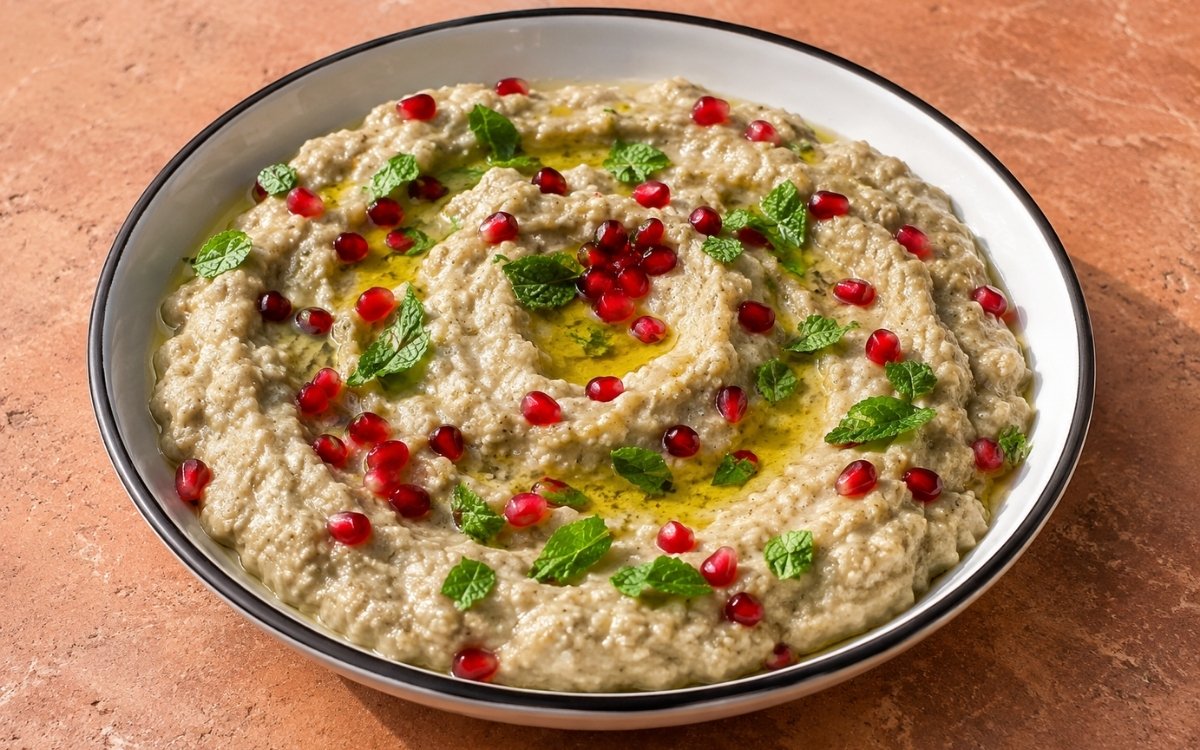
- Cover the bowl and allow to rest at room temperature for 20–30 minutes before serving. During this resting period the flavours integrate — the garlic mellows further, the lemon and tahini distribute evenly through the eggplant, the cumin's aromatic compounds bloom through the oil, and the overall flavour shifts from the sum of individual components to the cohesive, balanced spread that baba ganoush is at its best. Before serving, taste once more and make any final adjustments. Spread the baba ganoush into a shallow serving bowl using the back of a spoon — creating a slight well in the centre. Drizzle generously with extra-virgin olive oil. Scatter pomegranate seeds over the surface — their sweet-tart burst specifically amplifies the smoky eggplant and rich tahini rather than simply decorating it. Scatter fresh mint leaves for the clean aromatic counterpoint.
Notes
Italian eggplants are specifically preferred over large globe eggplants for baba ganoush for two reasons. Italian eggplants have fewer and less bitter seeds than globe varieties — the seeds are the primary source of the bitter edge that can make baba ganoush taste harsh rather than smooth. They also have a higher flesh-to-skin ratio and a denser, less watery flesh that concentrates more flavour during roasting and drains less liquid after peeling. Globe eggplants work but require more draining time and produce a slightly more bitter, more watery result.
The charring level is a matter of personal preference within a specific range. Light charring — blistered skin with moderate char marks — produces a mildly smoky result that is delicate and clean. Heavy charring — deeply blackened skin across most of the surface — produces a more intensely smoky, more complex, more assertively flavoured baba ganoush. Both are correct; the choice depends on how prominently smoky the intended result should be. What is not acceptable is insufficient roasting that produces pale, steam-softened flesh without any caramelisation — the eggplant's mild, slightly bitter raw character is not transformed without direct high heat and time.